
Principle and application
The consolidation test (oedometer) measures the compressibility of soft soil by applying increasing loads to an undisturbed specimen and reading the settlement over time. From it we obtain how much the soil will settle under the design load and how long it will take, the basis for sizing timelines and embankment surcharges.
Typical applications: embankments on soft soil, dams, port works and shallow foundations on clay.
The test in motion
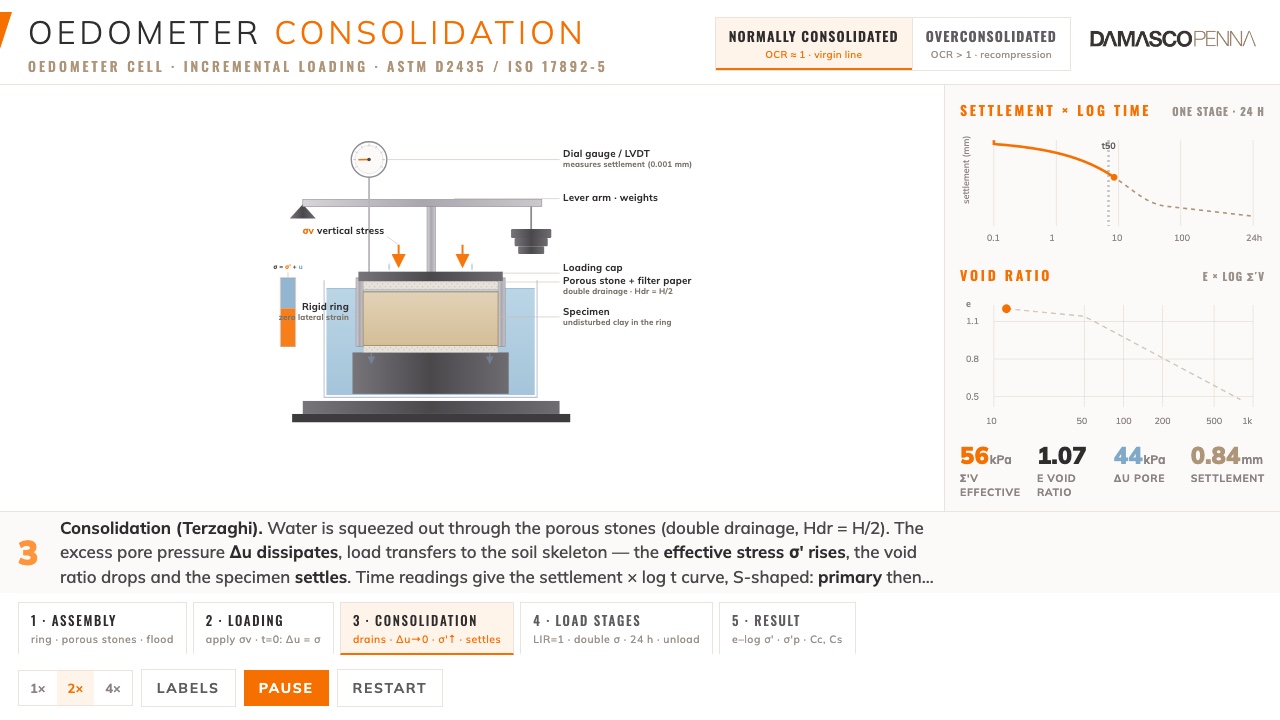
Interactive animation of the oedometer cell: the load is applied in stages that double the stress, water drains through the porous stones and the excess pore pressure transfers to the soil skeleton. Choose a normally consolidated or overconsolidated clay and follow the settlement × time curve and the e × log σ′ curve.
The test in stages
Trimming
Undisturbed specimen mounted in the oedometer cell.
Staged loading
Increasing loads are applied, each held until it stabilises.
Deformation reading
Settlement over time is recorded at each stage.
Parameters
The compression indices and the coefficient of consolidation are derived.
Quality controls: calibrated cells and dial gauges, control of saturation and load stages, digital recording of settlement over time and interpretation by a geotechnical engineer.
By the oedometer method
| Compressibility | Compression and recompression indices |
|---|---|
| Consolidation | Coefficient cv (rate) |
| Preconsolidation stress | Stress history of the soil |
| Settlement | Magnitude estimated under the design load |
| Test report | e-log(σ') curves and settlement over time |
| Parameters | Cc, Cr, cv and preconsolidation stress |
| Prediction | Input for settlement calculation |
| Typical lead time | According to the load stages and number of samples |
Performed to the same QA/QC, safety and site standard as every Damasco Penna service, described in Quality and field operations.
Frequently asked questions about the consolidation test
What is the consolidation test for?
The consolidation test (oedometer) measures the compressibility of soft soil by applying increasing loads to an undisturbed specimen and reading the settlement over time. From it we obtain how much the soil will settle under the design load and how long it will take, the basis for sizing timelines and embankment surcharges.
Does consolidation tell how long the soil takes to settle?
Yes. The coefficient of consolidation (cv) governs the rate; with it and the layer thickness, the time for settlement to occur is estimated, key information for the project schedule.
How does CPTu relate to consolidation?
The CPTu dissipation test estimates cv in situ, and the laboratory consolidation test confirms and details it on the undisturbed sample.
Related services
Consolidation testing for your project
Tell us about your project and we will prepare the investigation plan and the quote.