
Principle and application
SPT drilling (Standard Penetration Test) is the reference test of Brazilian geotechnics, standardised by NBR 6484. At every metre drilled, a standard sampler is driven by a 65 kg hammer falling from 75 cm, and the number of blows (N index) measures the strength of the soil, while at the same time the sample is recovered and the water table is recorded.
SPT percussion drilling is currently the most traditional form of geotechnical investigation in Brazil, present in practically every foundation project.
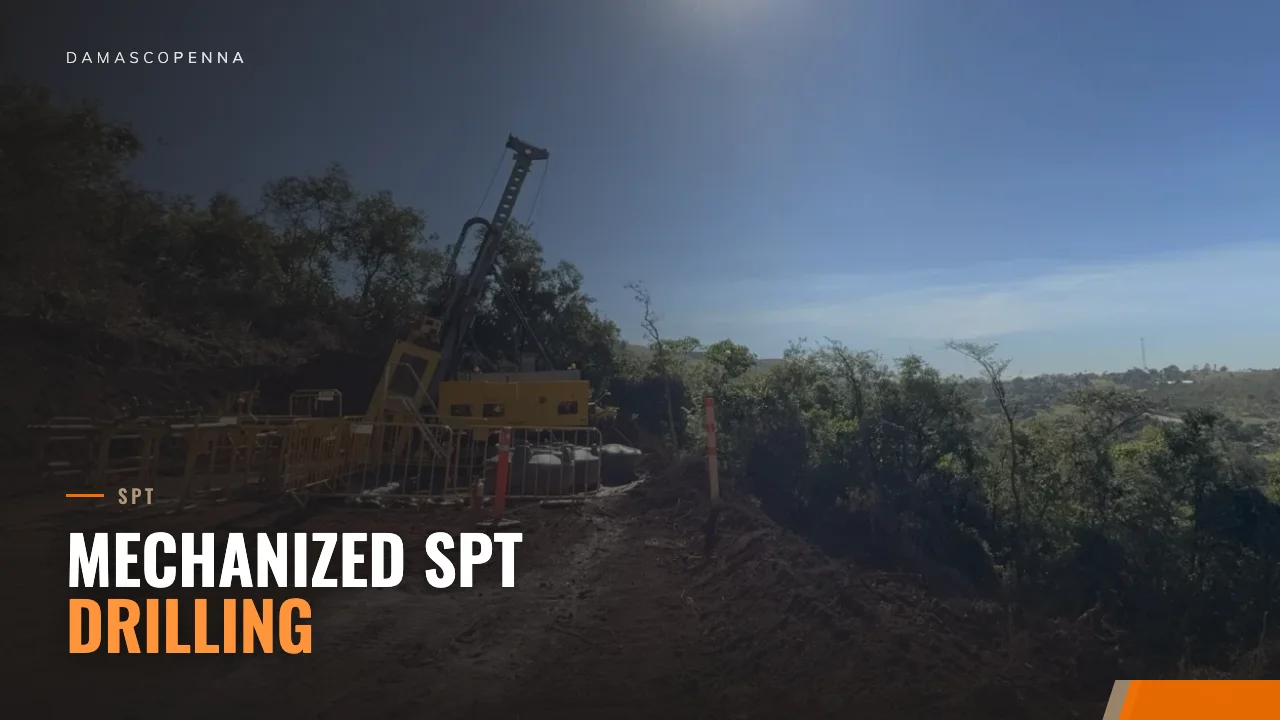
Following the international trend and the demands of specific clients, Damasco Penna operates equipment that carries out the test in a mechanized way, with an automatic SPT hammer and drilling by hollow-stem augers. The process ensures greater precision of the N index, higher productivity, more safety for the operators and the possibility of drilling without adding water.
Typical applications: buildings, urban infrastructure, industry, land subdivisions, highways and sanitation.
The test in motion
Before the step-by-step, watch the test in motion: the 65 kg hammer, the 75 cm free fall and the N-value count, per NBR 6484.
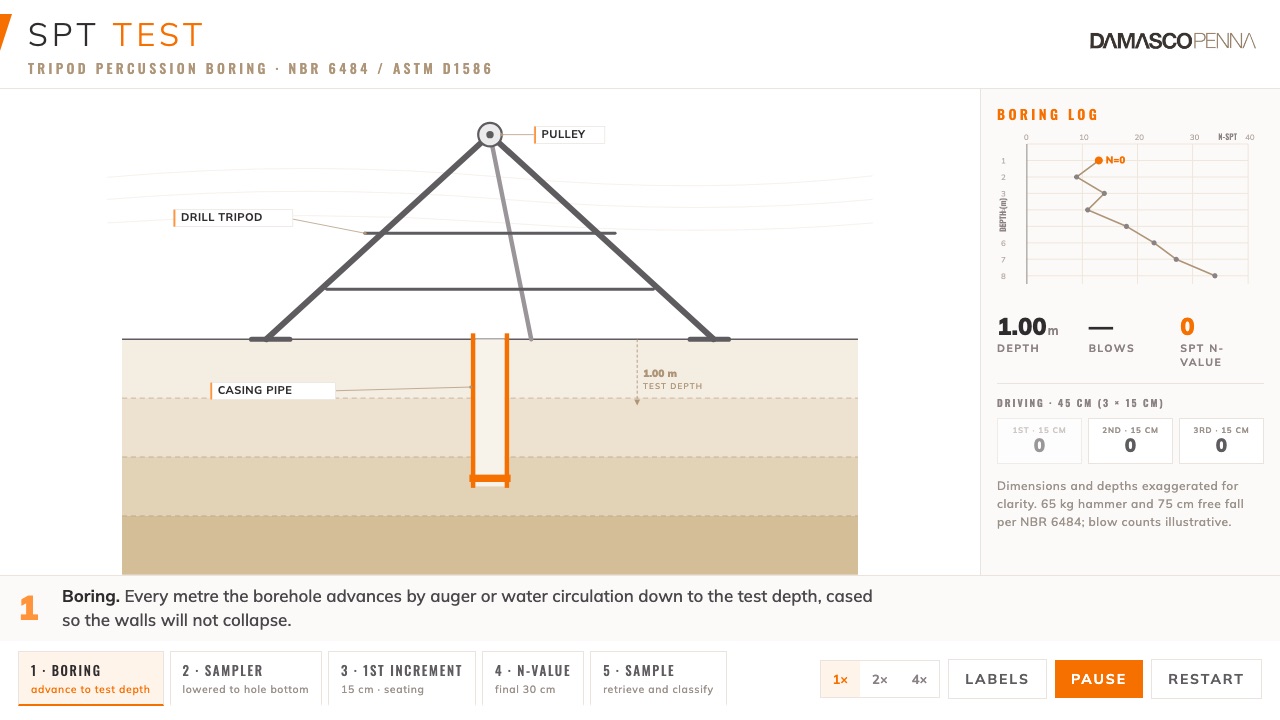
The test, step by step
Wash boring advance
The borehole is advanced by auger and water circulation down to the test depth.
Driving the sampler
The standard split-spoon sampler is driven by a 65 kg hammer falling from 75 cm.
N count
The number of blows to drive each 15 cm is counted; the N index is the sum of the last two intervals.
Sample and water table
The disturbed sample from every metre is recovered and the water table is recorded.
The test in the field
In accordance with NBR 6484
| N index | Penetration resistance (SPT) per metre |
|---|---|
| Profile | Tactile-visual description of the soil layers |
| Water table | Position of the groundwater level in the borehole |
| Samples | Material from each metre for characterisation |
The deliverable
| Borehole log | Profile with N index, layers, water table and elevation |
|---|---|
| Samples | Stored for laboratory characterisation when requested |
| Location plan | Layout showing the position of the boreholes |
| Typical turnaround | According to the number of boreholes and depth |
Frequently asked questions about the SPT drilling
What is SPT drilling for?
SPT drilling (Standard Penetration Test) is the reference test of Brazilian geotechnics, standardised by NBR 6484. At every metre drilled, a standard sampler is driven by a 65 kg hammer falling from 75 cm, and the number of blows (N index) measures the strength of the soil, while at the same time the sample is recovered and the water table is recorded.
What does the SPT N index mean?
It is the number of blows required to drive the final 30 cm of the standard sampler. The higher the N, the stronger the soil. It is the base parameter for sizing most foundations in Brazil.
When is the SPT not enough?
In very soft soils, where deformability and consolidation matter, the CPTu gives far more resolution. In rock, work moves to rotary or composite drilling. The SPT remains the starting point.
How many boreholes does my site need?
It depends on the area, the type of project and the variability of the soil. NBR 8036 sets the minimum number; the Damasco engineering team builds the plan with you.
Related services
SPT drilling for your project
Tell us the project context, we will put together the investigation plan and the quote.