
Principle and application
The piezocone test (CPTu) pushes an instrumented conical tip into the ground at a constant rate, measuring cone resistance, sleeve friction and pore pressure every 2 cm. The result is a continuous profile of the subsoil, obtained in real time and with no sampling, from which the stratigraphy and the strength and deformability parameters of the ground are derived.
The piezocone test, popular for many years in Europe and the United States, is today one of the main site investigation tools used in Brazil and stands as one of the finest geotechnical and environmental investigation tools available anywhere in the world. Beyond its speed and practicality, the equipment is compatible with a wide range of geological conditions, allowing stratigraphic identification almost instantly.
The static, constant-rate penetration of the piezocone is carried out by a hydraulic drilling rig, and the results are obtained in real time, transmitted to a computer in the field. Damasco Penna has been performing CPTu tests since 2007, with qualified crews and calibrated equipment, in accordance with the international standards of ISO-22.476-1.
The test, step by step
Penetration at constant rate
The conical tip is pushed at 2 cm/s by hydraulic reaction, with no impact and no soil removal.
Three simultaneous readings
Cone resistance (qc), sleeve friction (fs) and pore pressure (u2) recorded every 2 cm.
Real-time logging
Data appears on the computer during penetration, the profile is drawn on screen, layer by layer.
Dissipation test
Pauses to measure the decay of pore pressure and estimate the coefficient of consolidation, the key to predicting settlement.
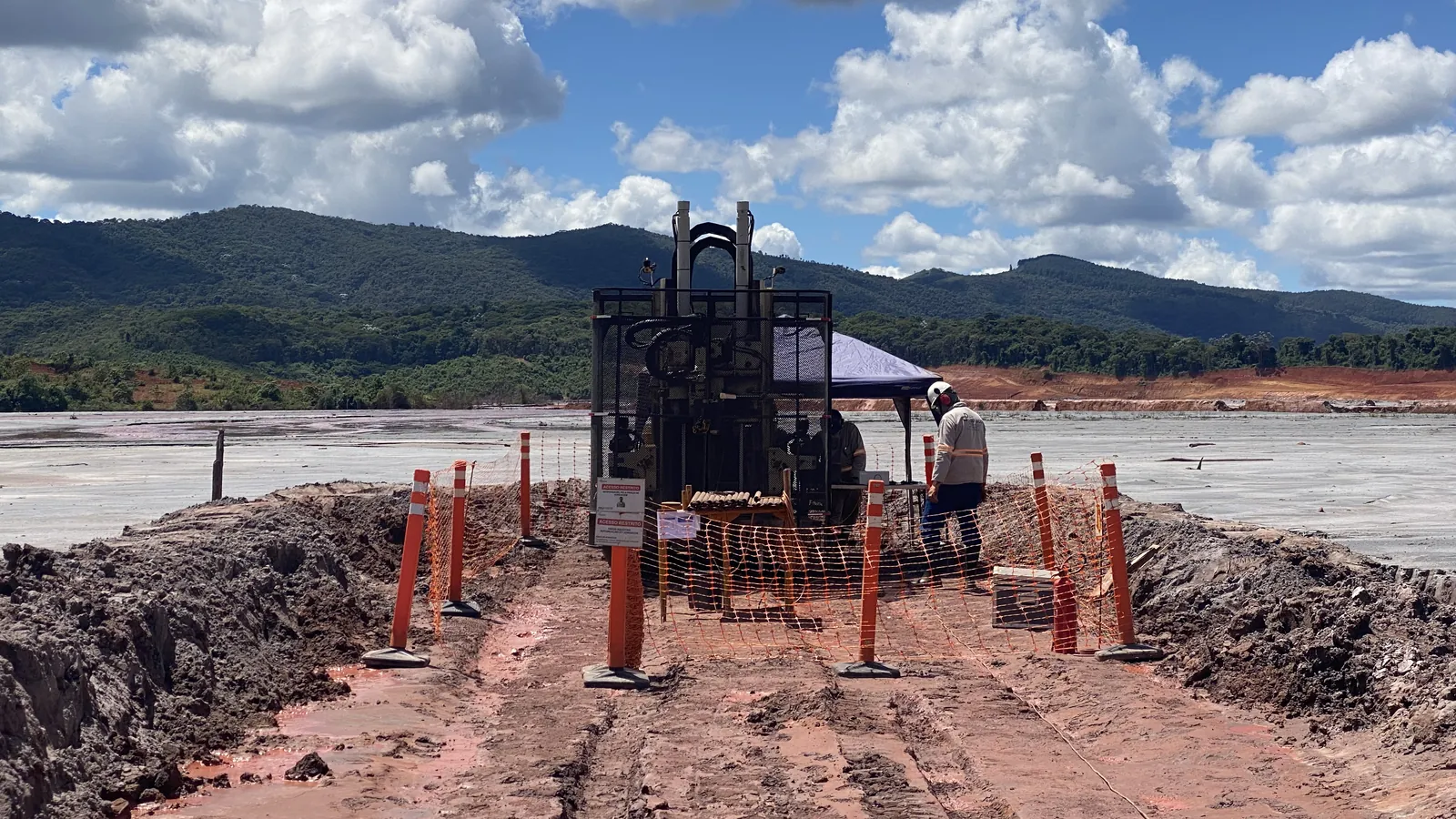
The test in the field

In accordance with ISO-22.476-1
| Stratigraphy | Continuous profile and soil behaviour type (SBT) |
|---|---|
| Strength | Undrained Su, friction angle, design Nkt |
| Deformability | Moduli and stress history (OCR) |
| Consolidation | Coefficient cv from the dissipation test |
Through correlations, the CPTu allows the stratigraphy and geotechnical profile to be assessed, along with the coefficient of consolidation (Ch and Cv), relative density (Dr), undrained shear strength (Su), the effective friction angle of sands, stress history (OCR) and the coefficient of permeability (K).
The deliverable
| Field log | qc, fs, u2 and Rf plots versus depth, with layer interpretation |
|---|---|
| Raw data | Digital file (.txt/.csv) for the designer to run their own correlations |
| Parameters | Su, OCR, cv and SBT classification, when interpretation is contracted |
| Typical turnaround | Preliminary log the same day; report according to scope |
Sectors and project types
Frequently asked questions about the CPTu Piezocone
What is the CPTu test for?
The piezocone test (CPTu) pushes an instrumented conical tip into the ground at a constant rate, measuring cone resistance, sleeve friction and pore pressure every 2 cm. The result is a continuous profile of the subsoil, obtained in real time and with no sampling, from which the stratigraphy and the strength and deformability parameters of the ground are derived.
What is the difference between CPT and CPTu?
The CPTu (piezocone) adds pore pressure measurement (u) to the conventional CPT. That reading is what makes it possible to identify soft layers, estimate consolidation and correct cone resistance, which is essential in fine, saturated soils.
Does the CPTu replace SPT drilling?
It does not replace it, it complements it. The CPTu gives a continuous profile and deformability parameters that the SPT does not provide; the SPT recovers samples and reaches stronger soils. In many projects the two are combined.
How deep can the CPTu reach?
It depends on the strength of the ground and the reaction available from the equipment. In soft soils it exceeds tens of metres; when very strong layers or gravel are encountered, work moves to composite drilling.
Can the CPTu predict settlement?
Yes. The dissipation test allows the coefficient of consolidation to be estimated and, with the derived moduli, the magnitude and rate of settlement.
Related services
CPTu Piezocone for your project
Tell us the project context, we will put together the investigation plan and the quote.