
What the CPTu measures
The CPTu (piezocone) is the field test that pushes an instrumented cone into the ground at a constant rate, continuously recording cone resistance, sleeve friction and the pore pressure generated during penetration. Combining these three channels makes it possible to define the stratigraphic profile almost in real time and to estimate strength and deformability parameters by correlation, with no need to retrieve and test samples.
Penetration at a constant rate
The CPTu evolved from the CPT (Cone Penetration Test), developed in the Netherlands in the 1940s, with the addition of electronic sensors and a pore pressure transducer. In Brazil the test has been in use since the 1950s and has become widely adopted in construction and mining over the past decades.
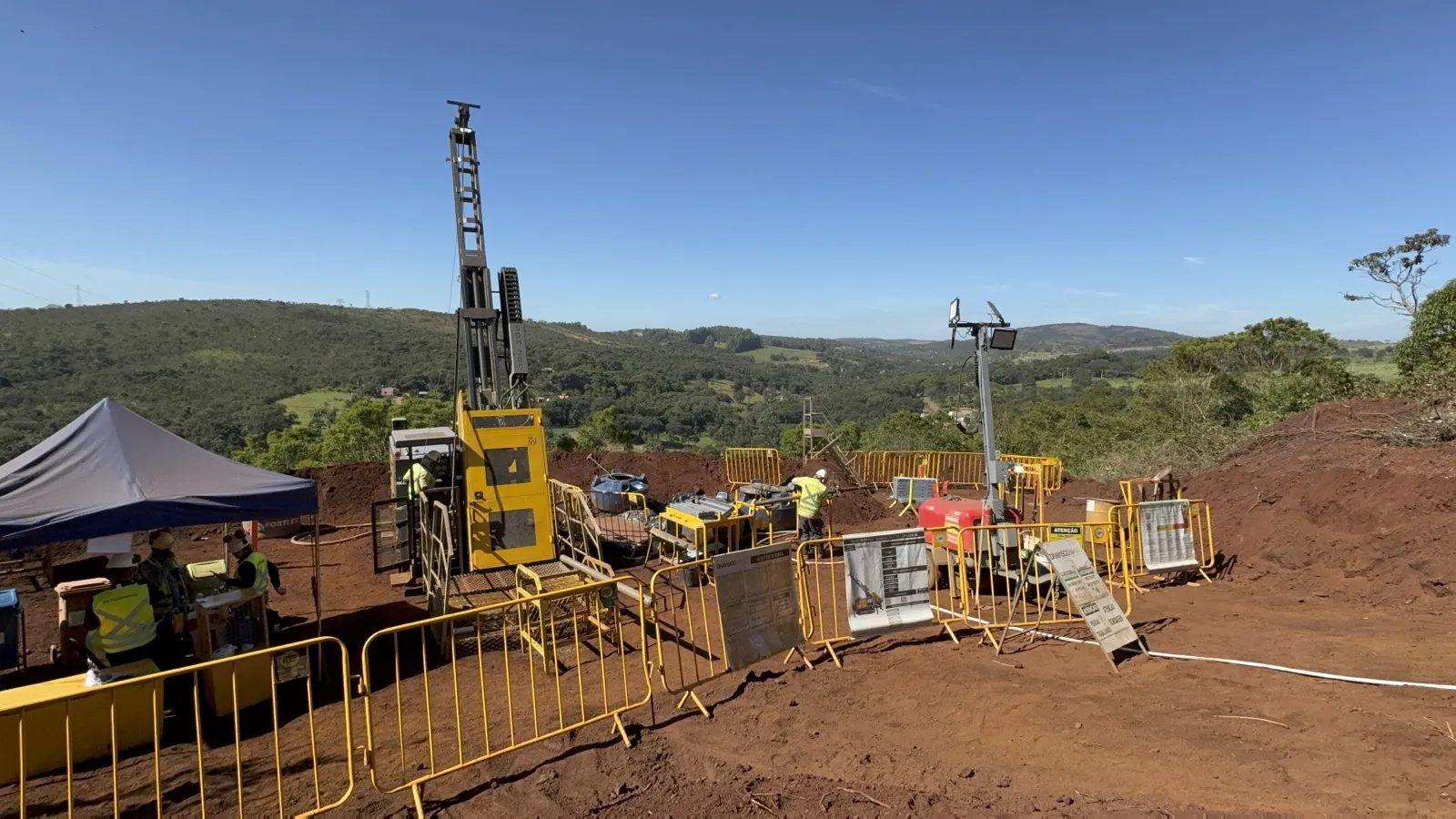
The test consists of pushing an instrumented cone into the ground at a constant rate of 2 cm/s, carried out by self-anchored hydraulic rigs that provide the required reaction. Throughout penetration, the system records readings every centimetre, producing a practically continuous profile of the subsurface.
Three channels and the cone tip
Three channels are measured directly: qc, the cone resistance; fs, the sleeve friction resistance; and u2, the pore pressure captured by a sensor positioned immediately behind the conical part. The u1 (at the tip) and u3 (behind the sleeve) positions exist, but are uncommon.
The cone tip is usually sized with a 10 cm² or 15 cm² projected area, dimensions regulated by standard. The sensors allow different sensitivity ranges: settings for lower pressures offer greater precision on low readings but may go out of range in strong soils, while settings for higher pressures preserve the reading in strong soils at the cost of precision in soft soils.
| qc | Cone resistance |
|---|---|
| fs | Sleeve friction resistance |
| u2 | Pore pressure measured behind the conical part |
| Cone tip | Cone with 10 cm² or 15 cm² projected area |
The dissipation test
Pore pressure behaviour depends on the permeability of the layer. In sandy, permeable soils, water is expelled almost instantly and penetration generates little or no excess pressure. In clayey soils of low permeability, penetration can generate high excess pressures whose full dissipation takes hours.
Taking advantage of this phenomenon, the dissipation test holds the cone tip at a specific depth and follows the decay of the excess pore pressure over time. To estimate permeability, dissipation of 50% of the excess pressure is awaited and the horizontal coefficient of consolidation (Ch) is calculated. The procedure also supports assessment of the water table.
The u2 sensor is a pore pressure transducer protected by a porous element made of plastic, metal or ceramic. Before the test, this element is vacuum-saturated for at least 24 hours in a viscous fluid, such as glycerine or silicone, to remove air bubbles that would compromise the reading. In less common configurations, the sensor may occupy the u1 (at the cone tip) or u3 (behind the friction sleeve) positions.
To estimate the water table, dissipation tests are carried out in more permeable, sandy layers, where full dissipation is rapid. Each test yields a pressure point; with a few points, the line of the hydrostatic pressure of the ground is drawn.
Charts and interpreted parameters
Results are presented in charts that bring together the raw sensor values (qc, fs and u2) against depth, alongside the geotechnical parameters interpreted through established correlations. This set makes it possible to classify the behaviour of the layers and to provide direct input for foundation, retaining structure and earthworks design.
Brief history
The CPTu test derives from the cone penetration test (CPT), developed in the Netherlands in the 1940s. As the method evolved, electronic sensors were incorporated into the cone tip, including the pore pressure transducer (u), consolidating the CPTu test.
In Brazil, CPT tests have been carried out since the 1950s, and the CPTu has become widely used in recent decades in the construction and mining industries. The interpretation of grain-size behaviour follows established correlations, such as those of Robertson & Campanella (1986).
Calibration and sensor sensitivity
The tip sensors are factory-set for specific pressure ranges. A cone calibrated for lower pressures is more precise on low readings but goes out of calibration if it exceeds the range it was sized for; a cone for higher pressures does not go out of calibration in strong soils but loses precision in very soft soils, such as tailings.
The working range of each sensor is stated in the calibration certificate of the cone tip, a document whose review is essential in any CPTu testing campaign.
Standards and references
The tests follow ISO-22.476-1 (Electrical cone and piezocone penetration tests) and ASTM D5778 (Standard Test Method for Electronic Friction Cone and Piezocone Penetration Testing of Soils).
For further study, we recommend the book Ensaios de Campo e suas aplicações à Engenharia de Fundações, the CPT Guide by Prof. Peter Robertson, available free of charge on the author's website, the book Cone Penetration Testing in Geotechnical Practice, and Prof. Robertson's series of webinars on the concepts of the test.
Technical summary
| Reference standard | ISO-22.476-1 |
|---|---|
| Method | Pushing an instrumented cone at 2 cm/s, readings every centimetre |
| Measured parameters | qc (cone resistance), fs (sleeve friction) and u2 (pore pressure) |
| Cone tip | Cone of 10 cm² or 15 cm², u2 sensor behind the conical part |
| Complementary test | Pore pressure dissipation for the Ch coefficient |
| Application | Stratigraphic profile and parameters in soft to strong soils |
The test in the field

Frequently asked questions about the CPTu
Which parameters does the CPTu measure directly?
Three channels are measured directly: qc, the cone resistance; fs, the sleeve friction resistance; and u2, the pore pressure captured by a sensor positioned immediately behind the conical part. The u1 (at the tip) and u3 (behind the sleeve) positions exist, but are uncommon.
At what rate is the cone pushed?
The instrumented cone is pushed at a constant rate of 2 cm/s by self-anchored hydraulic rigs that provide the required reaction. Throughout penetration, the system records readings every centimetre, producing a practically continuous profile of the subsurface.
What is the projected area of the cone tip used in the test?
The cone tip is usually sized with a 10 cm² or 15 cm² projected area, dimensions regulated by standard. The sensors allow different sensitivity ranges, either greater precision on low readings or greater reach in strong soils.
What is the dissipation test for?
The dissipation test holds the cone tip at a specific depth and follows the decay of the excess pore pressure over time. Dissipation of 50% of the excess pressure is awaited to calculate the horizontal coefficient of consolidation (Ch) and to support assessment of the water table.
CPTu for your project
Talk to us about your project. We put together the investigation plan and the quote.