
Principle and application
Direct shear and direct simple shear (DSS) testing for soil strength along defined planes.
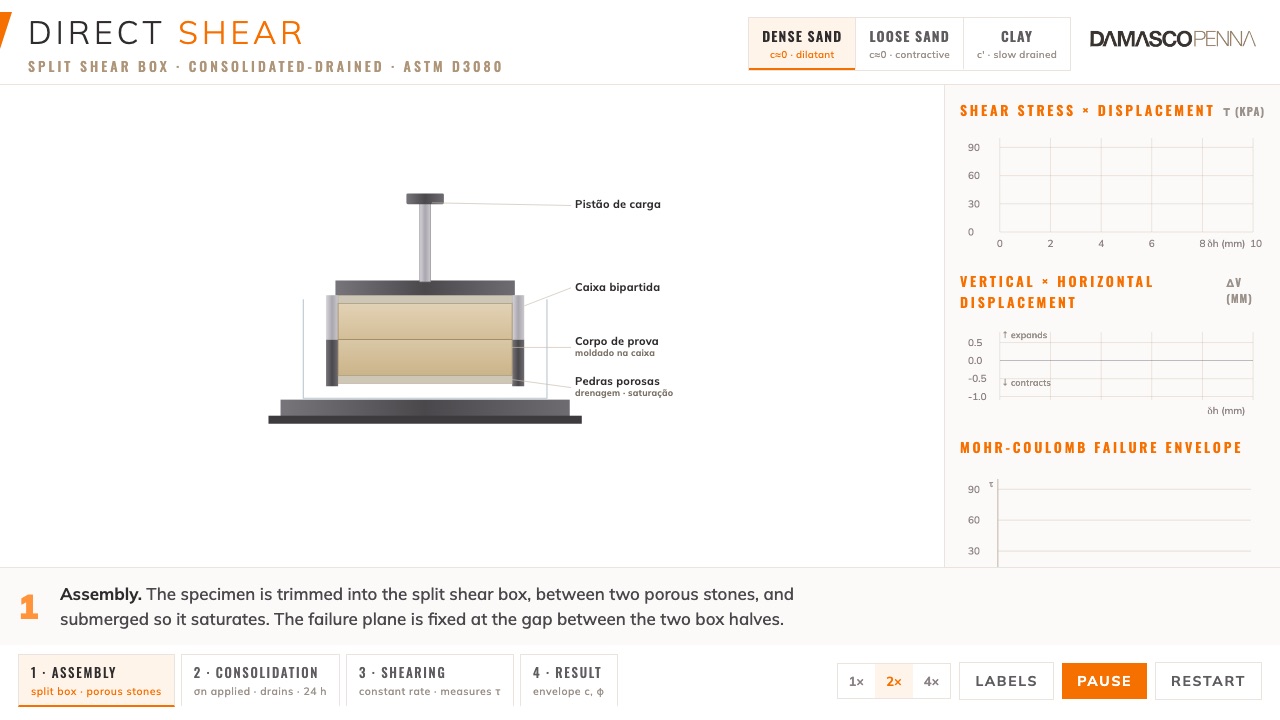
In the direct shear test, the specimen is confined in a split box and forced to fail along an imposed horizontal plane, under a known normal stress. Repeating the test at increasing normal stresses yields the soil strength parameters, cohesion and friction angle, which feed directly into slope stability, earth pressure and foundation bearing calculations.
Direct simple shear (DSS) applies shear strain distributed over the full height of the sample, with no forced failure plane, which better reproduces the loading of soft soils and tailings under cyclic loading. Part of the Soil Testing Laboratory area, it complements the Triaxial Test in determining shear strength.
The test in motion
Interactive animation of the split shear box: the specimen consolidates under the normal stress, the upper half slides at constant speed and the charts track shear stress, volume change and the Mohr-Coulomb envelope. Compare dense sand, loose sand and clay.
The test in steps
Trimming
The specimen is trimmed and set into the shear box or DSS cell, with control of moisture and density.
Consolidation
The normal stress is applied and consolidation is allowed, according to the design condition (drained or undrained).
Shearing
The moving half advances at a controlled rate, recording shear stress against displacement up to failure.
Envelope
Repeated at different normal stresses, the strength envelope is defined, with cohesion and friction angle.
To ASTM D3080
| Direct shear | ASTM D3080; imposed horizontal failure plane |
|---|---|
| DSS | ASTM D6528; distributed shear strain |
| Result | Cohesion and friction angle; undrained strength in soft soils |
| Condition | Drained or undrained, according to the design loading |
| Parameters | Soil cohesion and friction angle |
| Curves | Shear stress against displacement at each normal stress |
| Envelope | Shear strength envelope |
| Report | Test condition, standard and sample identification |
Quality controls: tests to ASTM D3080 and D6528, with calibrated cells and sensors, laboratory guided by ABNT, ASTM and ISO/IEC 17025 requirements, undisturbed sample preserved and tracked from field to test and normal stresses and shear rate set by the design condition.
Performed to the same QA/QC, safety and site standard as every Damasco Penna service, described in Quality and field operations.
Sectors and project types
Frequently asked questions about direct shear
What is the direct shear test used for?
The direct shear test determines the soil strength parameters, cohesion and friction angle, by forcing failure along a horizontal plane under a known normal stress. These parameters are the basis of slope stability, earth pressure and foundation bearing calculations.
What is the difference between direct shear and DSS?
In direct shear the failure is forced along an imposed horizontal plane. In DSS the shear strain is distributed over the full height of the sample, with no predefined failure plane, which better represents the loading of soft soils and tailings, including under cyclic loading.
When to use direct shear instead of triaxial?
Direct shear is simpler and faster and is suited to cases where the failure plane is known, such as soil-structure contacts or joints. The triaxial test offers fuller control of drainage and stresses. The two tests are complementary and the choice depends on what the project needs to assess.
Other services in this area
Direct shear for your project
Tell us about your project and we will put together the testing program and the quote.