
Principle and application
MASW (multichannel analysis of surface waves) measures the shear-wave velocity (Vs) profile without any drilling. A sledgehammer strikes a plate at the surface and about two thirds of the energy travels as a Rayleigh wave, recorded by a line of geophones. Because each wavelength samples a different depth, the wave disperses: processing extracts the dispersion curve and inversion adjusts a layered model until it reproduces the measurement, delivering the Vs profile with depth.
From the profile come Vs30, which defines the seismic site class (in Brazil, per NBR 15421), and the small-strain shear modulus (G0 = ρ·Vs²). Because it needs no borehole, MASW covers a site quickly and at low cost; at the critical points, calibration against crosshole, downhole or drilling confirms the model.
Typical applications: site classification and seismic response, sweeping large areas, dams and tailings dams, liquefaction assessment, embankments and pavements, and rational positioning of intrusive tests.
The test in motion
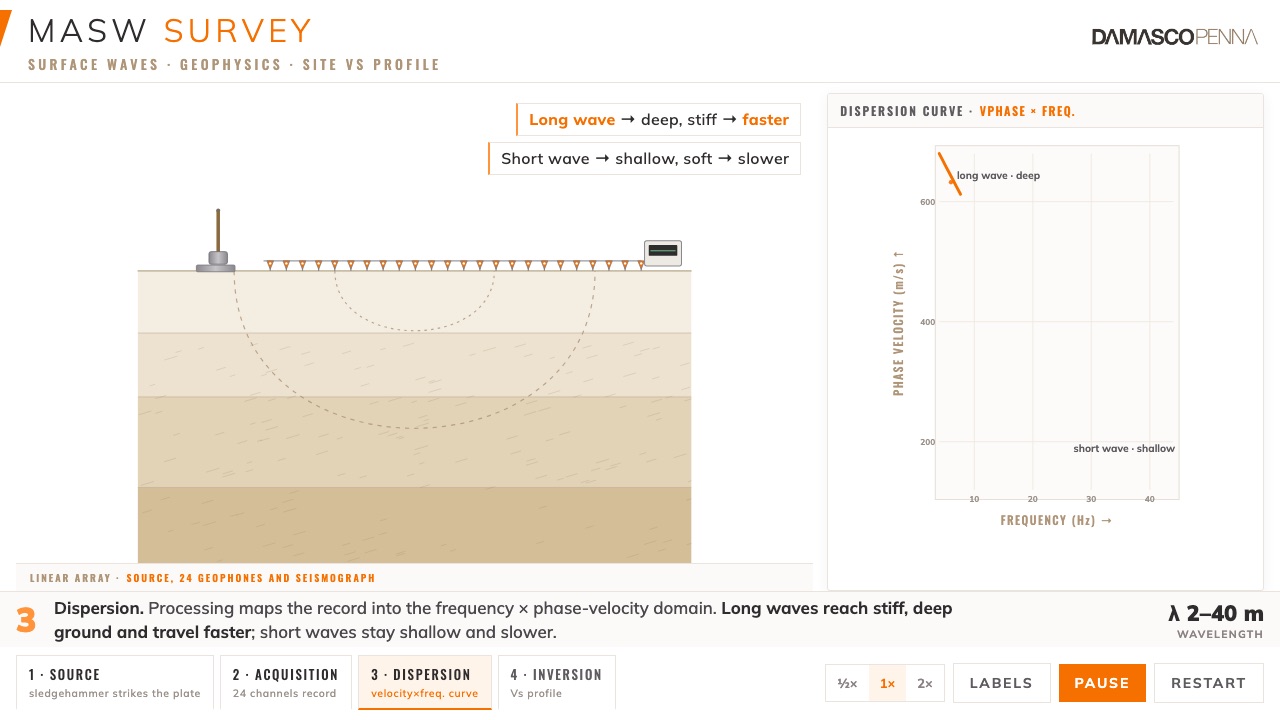
From source to profile: the blow on the plate, the Rayleigh wave running down the geophone line, the dispersion curve and the inversion that builds the Vs profile. The animation walks through the four stages of the method.
The test in stages
Array set up
A line of 24 low-frequency geophones (typically 4.5 Hz), spaced 1 to 2 m apart, is planted at the surface and connected to the seismograph.
Acquisition
The sledgehammer strikes the metal plate at defined positions along the line; each blow produces a multichannel record of the surface wave, with stacking to improve the signal.
Dispersion curve
Processing transforms the record into the frequency versus phase-velocity domain and extracts the Rayleigh-wave dispersion curve: long waves, which reach deep, stiff layers, travel faster.
Inversion and profile
A layered model is adjusted until its theoretical dispersion reproduces the measured curve, delivering the Vs profile, Vs30 and the dynamic moduli.
Quality controls: low-frequency geophones firmly planted and levelled, line and source geometry documented, stacking of blows and control of ambient noise, dispersion curve with a frequency range suited to the target depth and interpretation by a geophysics specialist, with calibration against intrusive tests whenever available.
To international practice and NBR 15421
The figure shows the field layout and the path from data to result: the dispersion curve, the inversion to the Vs profile and the Vs30 that sets the NBR 15421 site class.
MASW layout: 24 geophones of 4.5 Hz spaced 1 to 2 m apart; each wavelength samples a different depth. In the illustrative example, Vs30 ≈ 313 m/s, NBR 15421 class D (180 to 370 m/s).
| Method | Multichannel analysis of surface waves with an active source, established in the literature (Park, Miller and Xia, 1999) |
|---|---|
| Normative application | Vs30 and seismic site class per NBR 15421 (Brazilian seismic design standard) |
| Layout | Line of 24 geophones (4.5 Hz), 1 to 2 m spacing, sledgehammer and plate source |
| Vs | Profile by inversion of the Rayleigh-wave dispersion curve |
| Vs30 | Average velocity down to 30 m, with the corresponding site class |
| Dynamic moduli | G0 = ρ·Vs² per layer |
| Report | Methodology, records, dispersion curve, Vs profile and site class |
| Typical lead time | According to the number of lines and area covered |
Performed to the same QA/QC, safety and site standard as every Damasco Penna service, described in Quality and field operations.
Frequently asked questions about MASW
What is MASW used for?
To obtain the shear-wave velocity (Vs) profile without drilling. From it come Vs30 and the seismic site class required by seismic design, and the G0 modulus for preliminary dynamic analysis.
What depth does MASW reach?
With a sledgehammer source, typically 20 to 30 m. Heavier sources and longer arrays reach further; resolution, however, decreases with depth: thin, deep layers can no longer be individualised.
Does MASW replace drilling or the crosshole test?
No. MASW covers the site quickly and shows where the ground changes, but the inversion of the dispersion curve has no unique solution. Good practice uses MASW to sweep and position, and the intrusive test (drilling, crosshole, downhole) to confirm and calibrate at the points that matter.
Can MASW see a soft layer beneath a stiff one?
Yes, and that is an advantage over seismic refraction, which requires velocity to always increase with depth. Because the inversion uses the full dispersion of the surface wave, velocity reversals appear in the profile, although with lower resolution than the crosshole test.
Related services
MASW for your project
Tell us about your project and we will put together the investigation plan and the quote.