
Principle and application
Bridges, ports, crossings and dams need to know what lies beneath the water before founding. Over-water drilling brings the same rigour as investigation on land to the beds of rivers, reservoirs and coastal strips, defining the profile, the strength of the sediment and the bearing elevation of the structures.
Typical applications: ports, bridges, dams, crossings and dredging.
The test in stages
Platform setup
A barge or a set of pontoons is anchored and positioned over the investigation point.
Positioning and casing
The borehole is started with casing that spans the water column down to the bed.
Running the test
SPT, rotary drilling or CPTu are carried out from the platform, with the same procedure as on land.
Sampling and log
Samples and measurements are recorded in a georeferenced log, with bed elevation and water depth.
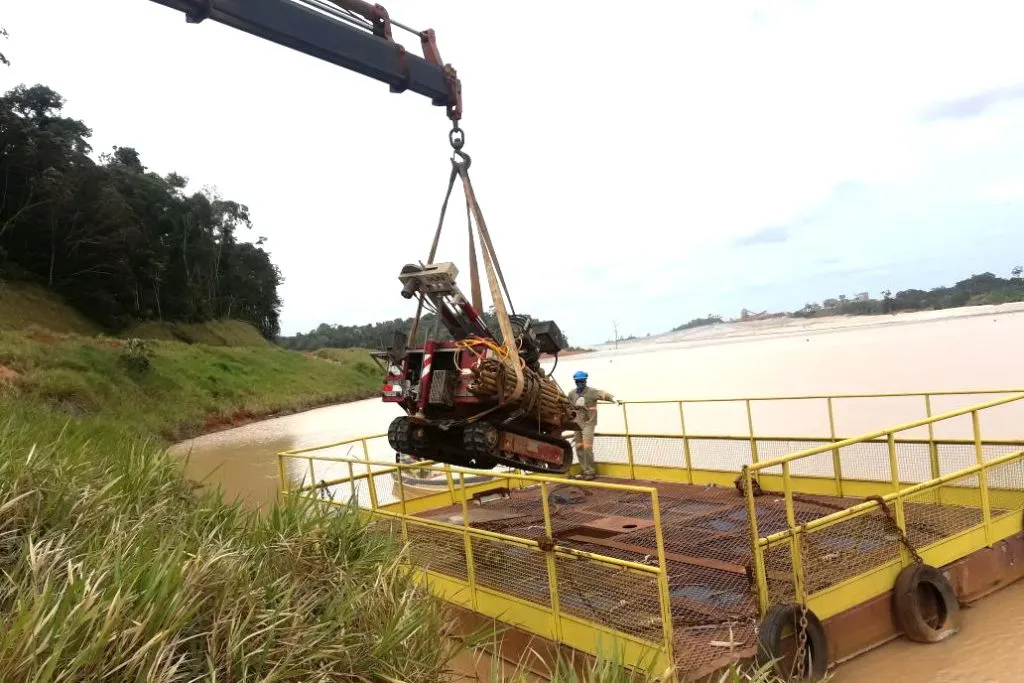
Quality controls: anchoring and platform stability verified before starting, casing that isolates the water column from the borehole, procedure identical to that on land, according to the method standard and georeferenced log, checked by an engineer.
What the test measures
| Methods | SPT (NBR 6484), rotary drilling and CPTu (ISO 22476) over the water |
|---|---|
| Platform | Barge or pontoons anchored, sized to the water depth |
| Georeference | Borehole position and bed elevation recorded |
| Sampling | Soil and rock from the bed, according to the method applied |
| Drilling log | Georeferenced profile with bed elevation and water depth |
| Samples | Soil and rock from the bed, according to the method run |
| Bearing elevation | Indication of a hard layer or rock head beneath the water |
| Typical lead time | According to water depth and borehole depth |
Performed to the same QA/QC, safety and site standard as every Damasco Penna service, described in Quality and field operations.
Frequently asked questions
What is over-water drilling used for?
Bridges, ports, crossings and dams need to know what lies beneath the water before founding. Over-water drilling brings the same rigour as investigation on land to the beds of rivers, reservoirs and coastal strips, defining the profile, the strength of the sediment and the bearing elevation of the structures.
How is over-water drilling carried out?
From a barge or floating platform anchored over the point. Casing spans the water column down to the bed, and the test (SPT, rotary or CPTu) is run with the same procedure as investigation on land, with the borehole position georeferenced.
Can CPTu be carried out over the water?
Yes. The piezocone can be pushed from the floating platform, delivering a continuous profile of resistance and pore pressure of the sediment beneath the bed, useful where the material is soft and conventional sampling is difficult.
Related services
This service for your project
Tell us about your project and we will prepare the investigation plan and the quote.