
Principle and application
A dual-tube system that isolates the borehole during driving, preventing cross-contamination between layers.
Two strings work together: an outer casing that stays in place, supporting the borehole, and lightweight inner rods that travel up and down carrying the liner with the sample. Because the borehole wall is cased at all times, the sample from each depth never touches the upper layers, and the recovered profile is continuous and intact, with no drilling fluid.
It is the method of choice where single-tube direct push reaches its limit: collapsing soils, sampling below the water table, and investigations where the stratigraphic integrity of the sample is a requirement of the study. Part of the Environmental Investigation area. Carried out to standard and with the same QA/QC and site discipline as the other Damasco Penna services.
Typical applications: environmental liabilities, contaminated sites, industry, due diligence, remediation and detailed stratigraphic profiles.
The system in motion
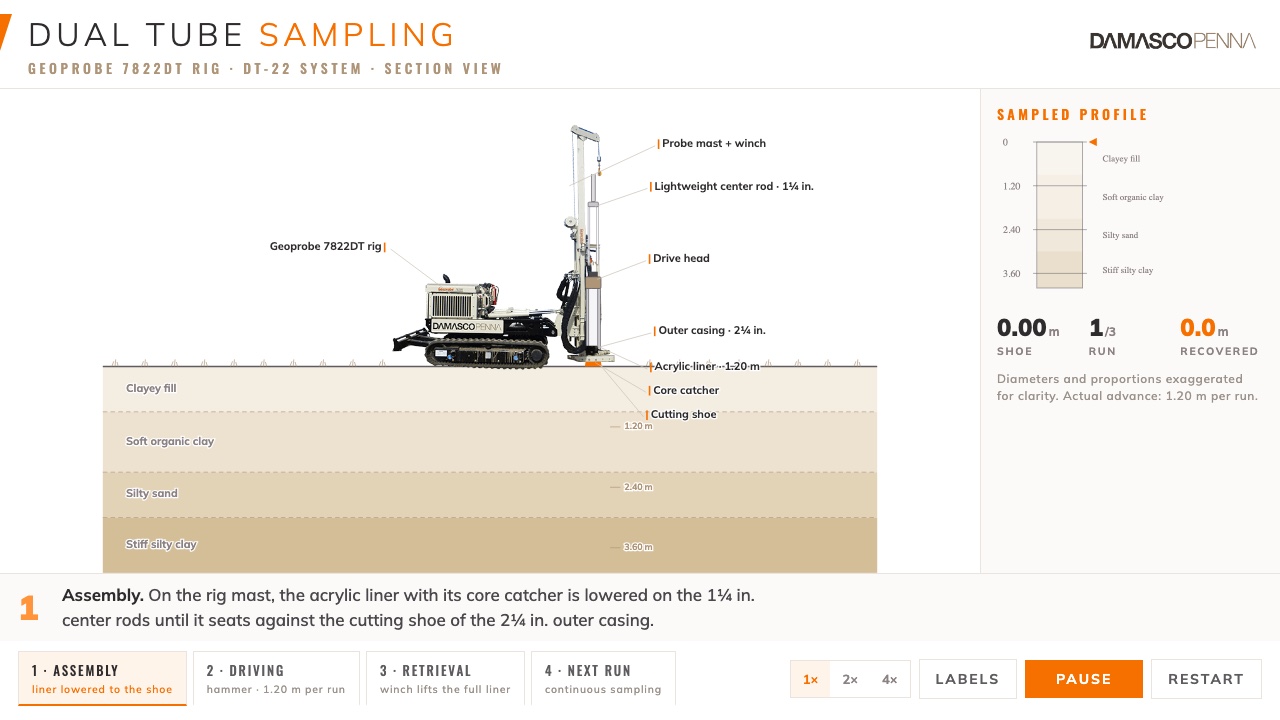
Interactive animation of the Dual Tube DT-22 cycle: assembly of the two strings, hammer driving, retrieval of the liner with the sample and the next run with the borehole cased.
The cycle in steps
Assembly
A 2¼ in. outer casing with a cutting shoe and lightweight inner rods holding an acrylic liner with a core catcher.
Driving
The percussion hammer drives both strings together, in 1.20 m runs. Soil enters through the shoe and fills the liner, with no drilling fluid.
Retrieval
The inner rods lift the full liner. The casing stays in place: the hole cannot collapse and the sample never touches the upper layers.
Next run
An empty liner goes back down and driving resumes: a continuous sample profile with no cross-contamination between layers.
Quality controls: A new liner for every sampling run, never reused, the driven casing isolates the sample from the upper layers, rods and casing decontaminated between holes and strict chain of custody and standardized field records.
To ASTM D6282
| System | Geoprobe DT-22 on the 7822DT rig, 2¼ in. casing |
|---|---|
| Reference | ASTM D6282 (direct push soil sampling for environmental site characterizations) |
| Sample | Continuous, in a liner with core catcher, 1.20 m runs |
| Borehole | Cased throughout driving, no drilling fluid |
| Samples | Continuous soil profile in liners, identified by point and depth |
| Profile | Description of the recovered material, layer by layer |
| Integrity | Sample isolated from the upper layers by the casing |
| Location | Grid of investigated points |
Performed to the same QA/QC, safety and site standard as every Damasco Penna service, described in Quality and field operations.
Frequently asked questions about Dual Tube Sampling
What is dual tube sampling used for?
Dual tube sampling recovers a continuous profile of soil samples for environmental investigation. Two strings are driven together: an outer casing that supports the borehole and inner rods with a liner that bring the sample to the surface. Because the borehole stays cased, the sample from each depth never comes into contact with the upper layers.
How is dual tube different from single-tube direct push?
In single-tube direct push, the sampling rod opens and closes the hole on every run. In dual tube, the outer casing stays driven while only the liner travels up and down. The hole cannot collapse between runs and the borehole wall cannot contaminate the sample, which matters in soft or unstable soils and when sampling below the water table.
Does dual tube use drilling fluid?
No. Driving is percussive and dry. With no drilling mud, the method generates little investigation-derived waste and preserves the natural condition of the sampled soil, a common requirement on sites under contamination assessment.
Other services in this area
Dual Tube Sampling for your project
Tell us about your project and we will put together the investigation plan and the quote.