
Principle and application
The triaxial test measures the strength and deformability of soil under controlled stress, reproducing the field stress state in the laboratory. The specimen, enclosed in a latex membrane, is placed in a cell where water applies the confining stress; a piston then applies the deviator stress up to failure. By shearing the specimen under drained or undrained conditions, the strength envelope is obtained (cohesion and friction angle); the Damasco Penna laboratory tests up to 5,000 kPa.
What sets the triaxial apart from the direct shear test is control. Drainage is commanded by the operator and pore pressure is measured throughout shearing. The same material therefore yields parameters in total stresses (c, φ) and in effective stresses (c', φ'), along with the stress path followed to failure. That is what allows the rapid loading of an embankment over soft clay and the long-term condition of a drained slope to be represented.
Three drainage conditions cover most design problems: UU, CIU and CID. The choice belongs to the design, not to the laboratory, and depends on how fast the load is applied relative to the ability of the soil to dissipate pore pressure. What each condition provides is summarised under Standard, parameters and deliverable.
Beyond strength, the test provides the stiffness of the material: deformation moduli at different stress levels and the volumetric behaviour, contractive or dilative. In tailings and loose saturated soils this behaviour is the central input for liquefaction susceptibility assessment. High-stress testing, up to 5,000 kPa, represents conditions the conventional range does not reach, such as the stresses inside tall dams, in waste rock piles and beneath deep foundations.
Typical applications: dams, slopes, deep foundations, embankments and mining.
The test in motion
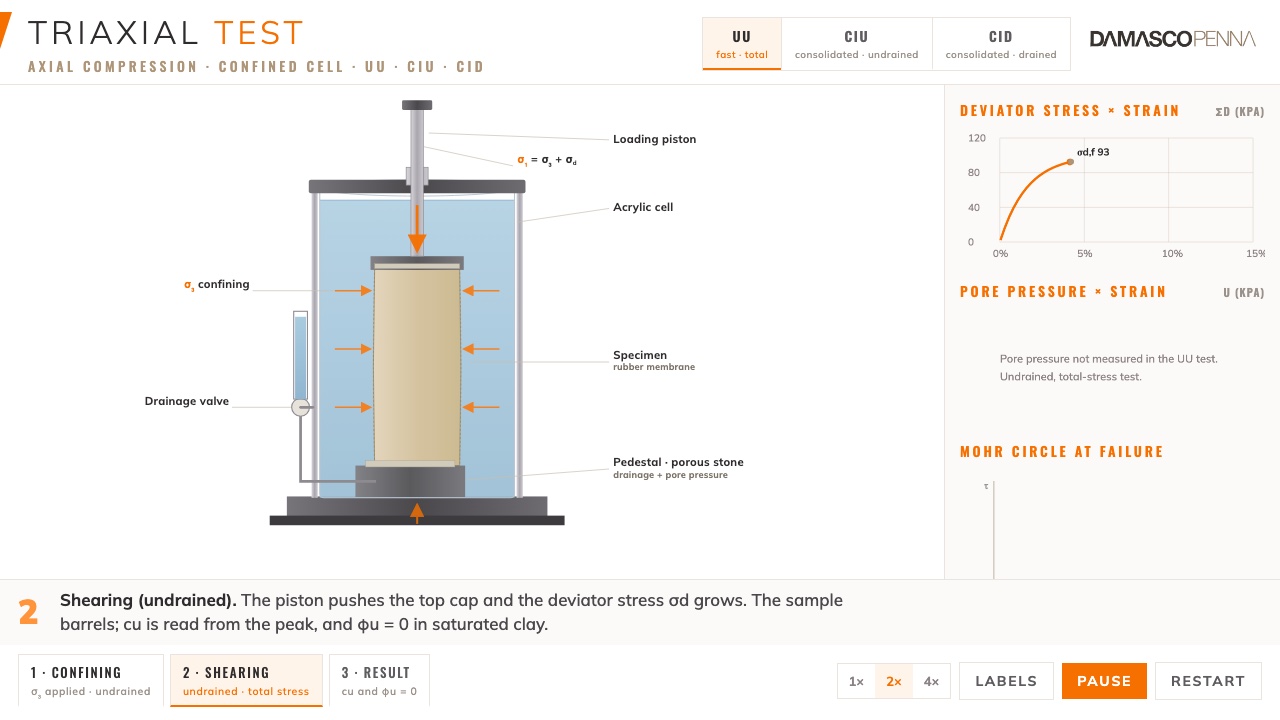
Interactive animation of the triaxial cell under the three drainage conditions: UU, CIU and CID. Each method shows its stages (saturation, consolidation and shearing) with the specimen deforming and the drain opening or closing as required.
The test in stages
Specimen trimming
The undisturbed sample, recovered in a Shelby tube, Denison sampler or block, is trimmed to a height-to-diameter ratio of 2:1 and mounted on the cell base, between porous stones and filter paper, enclosed by the membrane. Compacted material is moulded in the laboratory at the design moisture content and density.
Saturation by back pressure
Water and back pressure are applied in stages to dissolve the air remaining in the voids. Saturation is verified through Skempton's B parameter, and the test only moves on once the value reaches the level required by the standard.
Consolidation
Under the effective stress set by the design, the specimen consolidates isotropically or anisotropically, with volume change recorded over time. This stage fixes the reference stress of the result and, in clays, may take days.
Shearing
The piston applies the deviator stress at a rate consistent with the drainage condition: in the CIU, slow enough to equalise the pore pressure measured at the base; in the CID, slow enough to avoid generating excess pore pressure. Load, axial strain, volume change and pore pressure are recorded.
Interpretation
With the area and membrane corrections prescribed by the standards, stress-strain curves, stress paths and Mohr circles are assembled. Cohesion and friction angle are read from the envelope, in total and effective stresses.
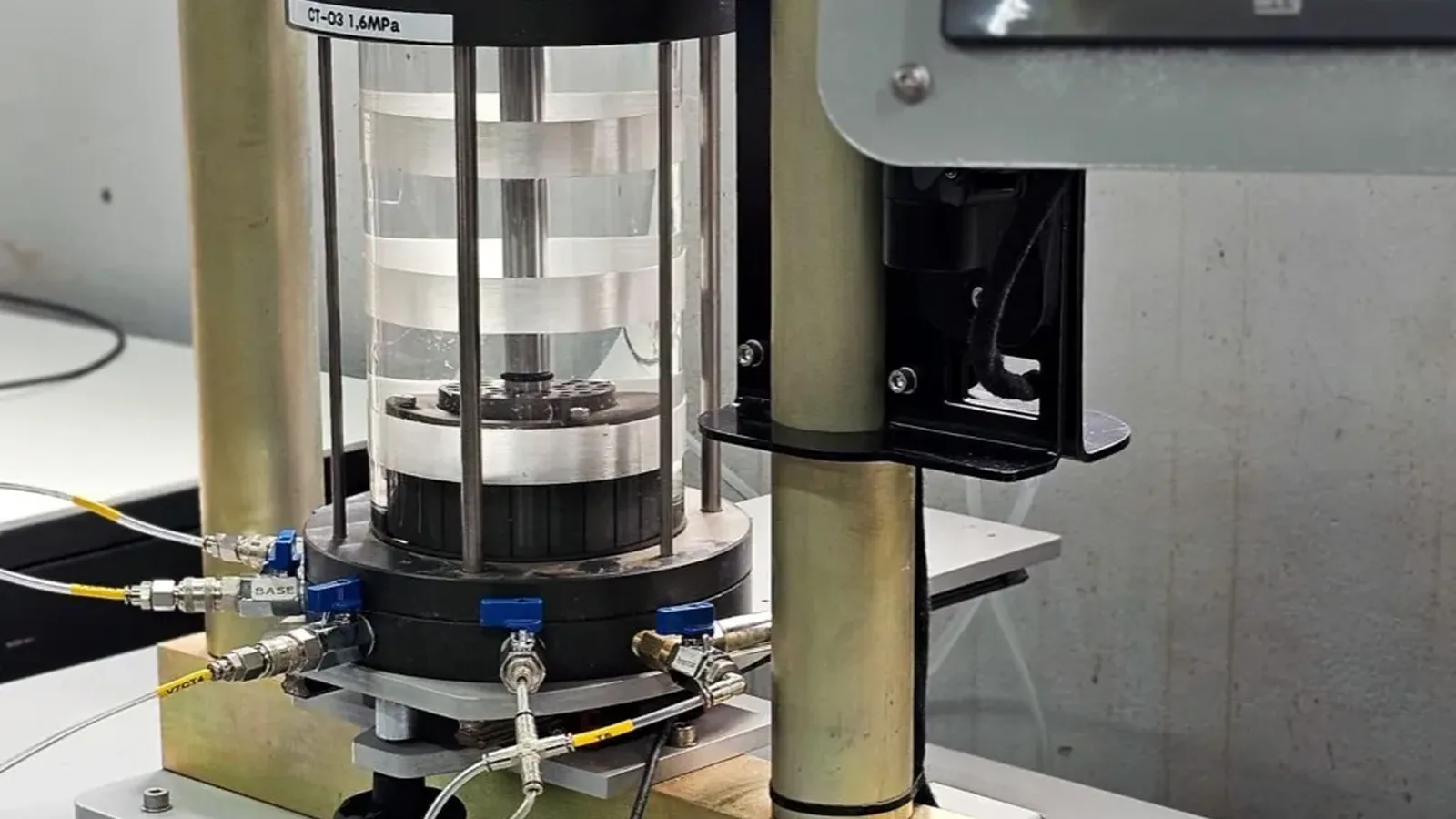
Quality controls: calibrated and traceable load frames and transducers, saturation verified through the B parameter, consolidation controlled by volume change, shearing rate set by the drainage condition, continuous digital recording of load, strain and pore pressure, area and membrane corrections to the standards, and interpretation and report by an engineer.
To ASTM D2850, D4767 and D7181
Each drainage condition has its own standard and answers a different design question.
| UU · ASTM D2850 | Unconsolidated and undrained. Provides the undrained shear strength (Su) in total stresses, for rapid loading over saturated cohesive soil: embankments over soft clay, temporary cuts and short-term stability. |
|---|---|
| CIU · ASTM D4767 | Isotropically consolidated and undrained, with pore pressure measurement. Provides effective parameters (c', φ') and the stress path, with a single consolidation stage per specimen. It is the condition most often requested for dams and tailings. |
| CID · ASTM D7181 | Consolidated and drained. Provides effective parameters with direct measurement of volume change, for the long-term condition: drained slopes, sands and permeable soils. |
| ISO 17892-9 | International reference for consolidated triaxial tests on saturated soils, including anisotropic consolidation (CAU and CAD). |
What the test delivers, under any of the conditions:
| Strength | Cohesion (c) and friction angle (φ), in total and effective stresses |
|---|---|
| Stress path | Path followed to failure, drained or undrained |
| Pore pressure | Measured during shearing (CIU) and verified at saturation (B parameter) |
| Deformability | Stress-strain curves, moduli and volumetric behaviour |
| High stress | Testing up to 5,000 kPa |
| Test report | Curves, Mohr circles, strength envelope and test conditions |
| Typical lead time | According to the number of specimens and the permeability of the soil |
Performed to the same QA/QC, safety and site standard as every Damasco Penna service, described in Quality and field operations.
Frequently asked questions about the triaxial test
What is the triaxial test for?
The triaxial test measures the strength and deformability of soil under controlled stress, reproducing the field stress state in the laboratory. By shearing the specimen under drained or undrained conditions, the strength envelope is obtained (cohesion and friction angle); the Damasco Penna laboratory tests up to 5,000 kPa.
What is the difference between CIU, CID and UU?
They are drainage conditions: UU (unconsolidated, undrained), CIU (isotropically consolidated, undrained, with pore pressure measurement) and CID (consolidated, drained). The choice depends on the design situation to be represented: rapid loading over saturated soil calls for UU or CIU; the long-term condition, with pore pressure dissipated, calls for CID.
How many specimens are required?
The strength envelope is defined by at least three specimens tested under different confining stresses, chosen around the design stresses. A single specimen provides one point, not an envelope.
What kind of sample does the test require?
For natural soil, an undisturbed sample recovered in a Shelby tube, Denison sampler or block, transported and stored without loss of moisture and without disturbance. For compacted material, such as embankments, dams and piles, the specimen is moulded in the laboratory at the design moisture content and density.
How long does a triaxial test take?
It is a long test. Saturation and consolidation take up most of the schedule and depend on the permeability of the soil: hours in sands, days per specimen in soft clays and fine tailings. Lead time is set per series, according to the number of specimens and the stresses requested.
Triaxial or direct shear?
The direct shear test is faster and cheaper, but it imposes the failure plane and does not allow pore pressure measurement or drainage control with the same rigour. When the design calls for effective parameters, the stress path or the analysis of saturated soil under rapid loading, the triaxial is the test to run.
What is the B parameter and why does it matter?
It is the ratio between the increase in pore pressure and the increase in confining stress applied with drainage closed, and it measures the degree of saturation of the specimen. If the sample is not saturated, the pore pressure measured during shearing does not represent the field condition and the effective parameters come out wrong.
Is the test suitable for mine tailings?
Yes. In tailings and loose saturated soils the interest lies in the volumetric behaviour and in the peak and residual undrained strength, used in liquefaction susceptibility assessment. These tests demand fine control of saturation and of the shearing rate.
Why test up to 5,000 kPa?
Tall dams and deep foundations impose high stresses. The Damasco laboratory tests at this range to represent those real conditions.
Related services
Triaxial testing for your project
Tell us the project context, the type of material and the stresses of interest. We define the test series, advise on the appropriate drainage condition and send the quote. If sampling has not been carried out yet, undisturbed recovery is ours as well.