
Principle and application
Soil characterization tests classify the soil from its basic properties: moisture content, particle-size distribution, Atterberg limits, unit weight and compaction. They are the starting point of any design, from fill control in earthworks to the subgrade in pavement.
Typical applications: earthworks, pavement, embankments, compaction control and foundations.
The test in motion
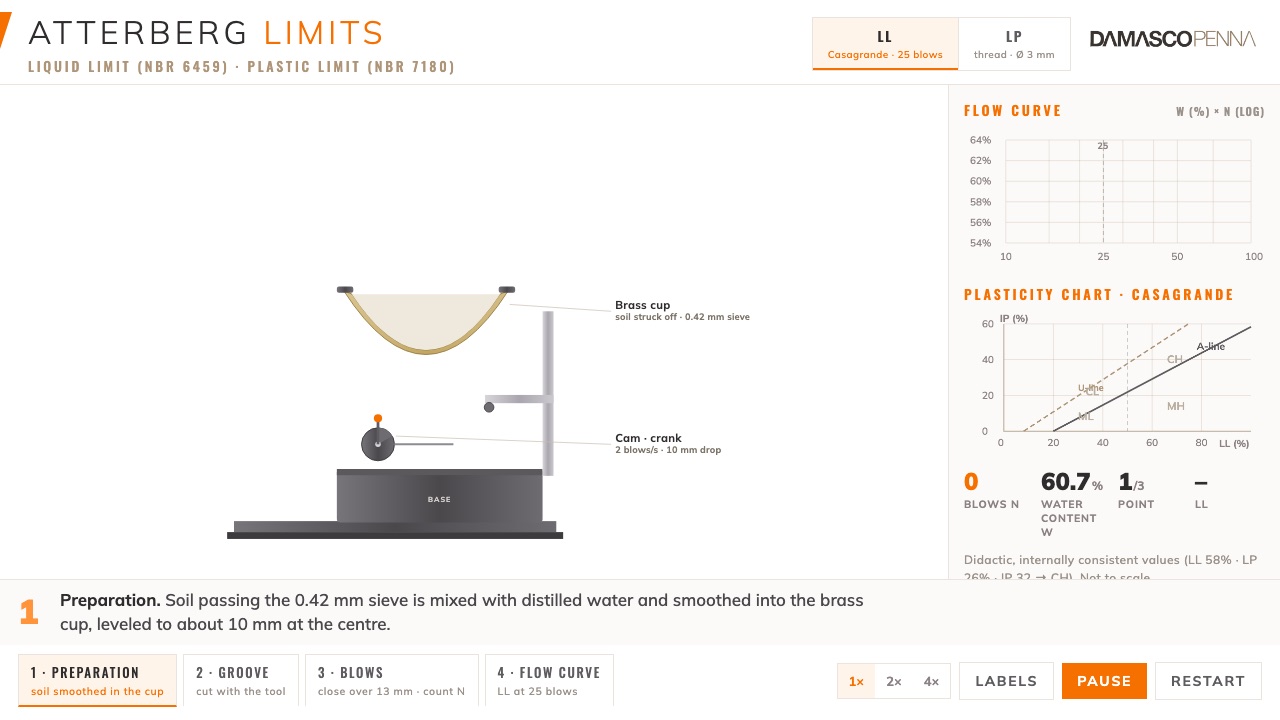
Interactive animation of the Atterberg limits: in the Casagrande cup, the groove closes blow by blow until the liquid limit is defined; in the PL mode, the 3 mm thread crumbles at the plastic limit. The results are plotted on Casagrande's plasticity chart.
The test in stages
Moisture and unit weight
Determination of the natural moisture content and the unit weight.
Particle-size distribution
Sieving and sedimentation for the grain-size distribution.
Atterberg limits
Liquid and plastic limits for fine-grained soils.
Compaction
Standard/modified Proctor and, on request, CBR and Hilf.
Quality controls: calibrated balances, ovens and sieves, procedures to the current testing standards, duplicates and repeatability control and report reviewed before delivery.
For soil classification
| Particle size | Grain-size distribution curve |
|---|---|
| Atterberg | LL, PL and plasticity index |
| Unit weight | Bulk and specific gravity of grains |
| Compaction | Optimum moisture and maximum density |
| Characterization report | Curves, indices and soil classification |
| Compaction | Proctor curve and parameters |
| CBR/Hilf | When contracted |
| Typical lead time | According to the number of samples |
Performed to the same QA/QC, safety and site standard as every Damasco Penna service, described in Quality and field operations.
Frequently asked questions about soil characterization
What are soil characterization tests for?
Soil characterization tests classify the soil from its basic properties: moisture content, particle-size distribution, Atterberg limits, unit weight and compaction. They are the starting point of any design, from fill control in earthworks to the subgrade in pavement.
What do the Atterberg limits indicate?
The behaviour of fine-grained soils with moisture: the liquid limit and the plastic limit define the plasticity index, used in classification and in predicting soil behaviour.
What is the compaction test for?
It determines the optimum moisture and the maximum density of the soil, the basis for controlling fills and subgrade in earthworks and pavement.
Related services
Soil characterization for your project
Tell us about your project and we will prepare the investigation plan and the quote.