
Principle and application
Determines the soil's optimum moisture content and maximum dry density for fill and subgrade control.
Every compacted soil has a moisture content at which it reaches the highest dry density possible for a given compaction energy. The Proctor test finds that pair of values: the sample is compacted in a standardized mold at increasing moisture contents, and the result is the compaction curve, with the maximum dry density and the optimum moisture content. These two numbers are what the design uses as the reference to specify and inspect any engineered fill.
Damasco Penna runs the test at standard, intermediate and modified energies, as specified by the design, in the central laboratory or in the mobile earthworks laboratories set up on site. For expedited compaction control in the field, the laboratory also runs the Hilf method, and the mini-Proctor on 3 in. samples, which allows checking the degree of compaction even in deep layers of existing fills. Part of the Soil Testing Laboratory area.
The test in motion
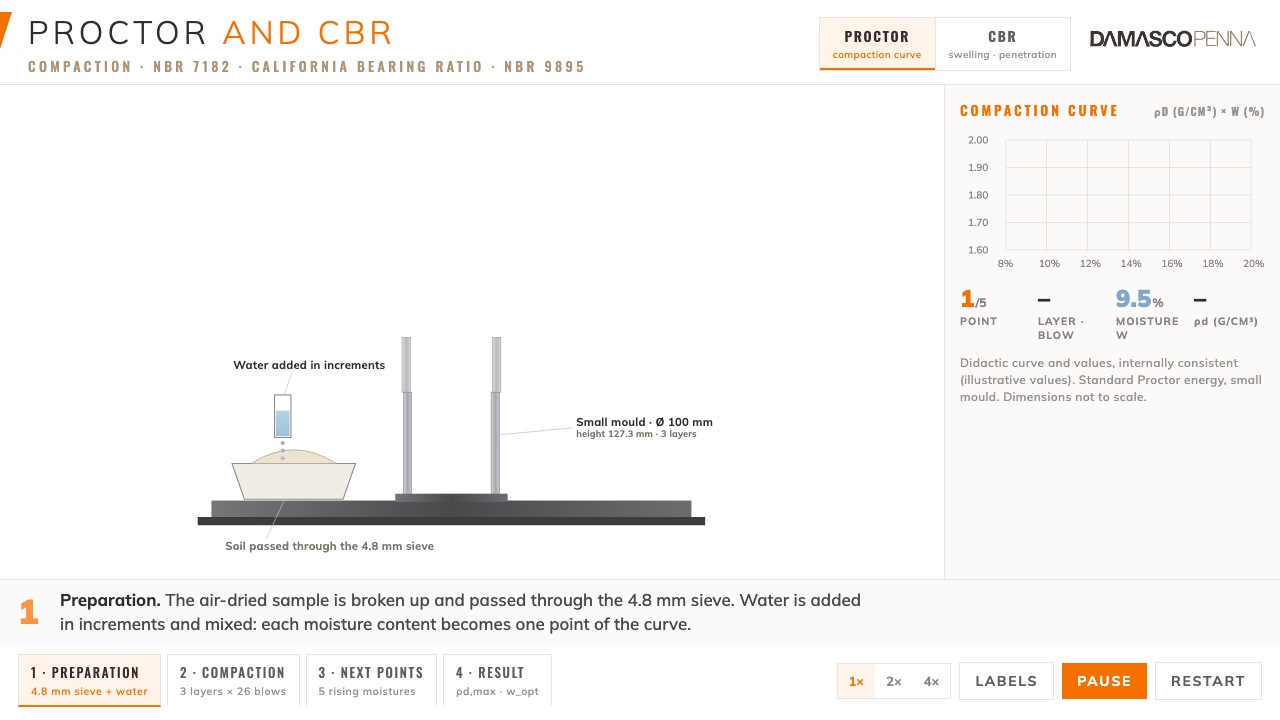
Interactive animation of Proctor compaction: the sample is passed through the 4.8 mm sieve, receives water in increments and is compacted in layers inside the mould. Each moisture content becomes one point of the curve, until the maximum dry density and the optimum moisture appear. A selector switches to the CBR test.
The test in steps
Sample preparation
Drying, breaking up and homogenizing the soil, divided into portions at increasing moisture contents.
Compaction
Each portion is compacted in a standardized mold, in layers, with the rammer and energy defined by NBR 7182 (standard, intermediate or modified).
Weighing and moisture
Each compacted specimen is weighed and has its moisture content determined, producing one point of the curve.
Compaction curve
With the points plotted, the maximum dry density and the optimum moisture content are obtained, becoming the fill control reference.
To NBR 7182
| Reference | NBR 7182 (soil compaction test); ASTM D698 and D1557 |
|---|---|
| Energies | Standard, intermediate and modified, as specified by the design |
| Result | Maximum dry density and optimum moisture content |
| Complements | Hilf method for expedited control; mini-Proctor on 3 in. samples |
| Curve | Full compaction curve for each tested sample |
| Parameters | Maximum dry density and optimum moisture content |
| Report | Sample identification, energy used and reference standard |
| Use on site | Reference for the degree of compaction required by the specification |
Quality controls: test performed to NBR 7182 with calibrated equipment, laboratory guided by ABNT, ASTM and ISO/IEC 17025 requirements, samples identified and tracked from site to report and mobile earthworks laboratories on site when the project demands fast turnaround.
Performed to the same QA/QC, safety and site standard as every Damasco Penna service, described in Quality and field operations.
Sectors and project types
Frequently asked questions about Proctor Compaction
What is the Proctor compaction test used for?
The Proctor test determines the maximum dry density and the optimum moisture content of a soil for a given compaction energy. These two values are the design and inspection reference for engineered fills: the degree of compaction required by the specification is calculated against them.
What is the difference between standard, intermediate and modified Proctor?
The difference is the compaction energy applied, increasing from standard to modified. The higher the energy, the higher the maximum dry density and the lower the optimum moisture content. The energy is defined by the design specification: regular fill layers usually use standard energy, while more demanding layers, such as pavement layers, call for higher energies.
What is degree of compaction?
It is the ratio, as a percentage, between the dry density obtained in the field and the maximum obtained in the laboratory Proctor test. Specifications usually require values between 95% and 100%, depending on the layer. Damasco Penna's laboratory runs both the reference test and the field control, including the Hilf method for fast answers on site.
Other services in this area
Proctor Compaction for your project
Tell us about your project and we will put together the testing program and the quote.