
Principle and application
Developed by the engineer Louis Ménard in France in the 1950s, the Ménard pressuremeter (PMT) is a device with an expandable membrane for measuring the strength, the stiffness and the in situ stresses of the soil. It is the main form of geotechnical investigation used in France, with an extensive body of literature, and is well suited to obtaining the stress-strain relationship of the layers investigated.
Typical applications: deep foundations and piles, shallow foundations, projects where in situ stiffness matters, french method (Fascicule 62), saturated clays and sandy soils and industry and ports.
The test in stages
Pre-boring the hole
The pressuremeter probe is inserted into a previously drilled hole, with a diameter slightly larger than that of the probe.
Positioning at depth
The probe is lowered to the test depth, at the level where the soil behavior is to be measured.
Applying radial pressure
A uniform radial pressure is applied to the borehole wall by injecting water and nitrogen, expanding the membrane against the soil.
Recording the pressure-volume curve
The applied pressure and the volume expansion of the probe are measured and recorded in the control box, yielding the stress-strain relationship of the layer.
Quality controls: probe and membrane calibrated and verified before each campaign, controlling the volume and pressure losses, pre-boring with a controlled diameter, matched to the probe, so the borehole wall is not disturbed, auditable recording of pressure and volume throughout the test and interpretation and report reviewed by a geotechnical engineer.
The test in the field
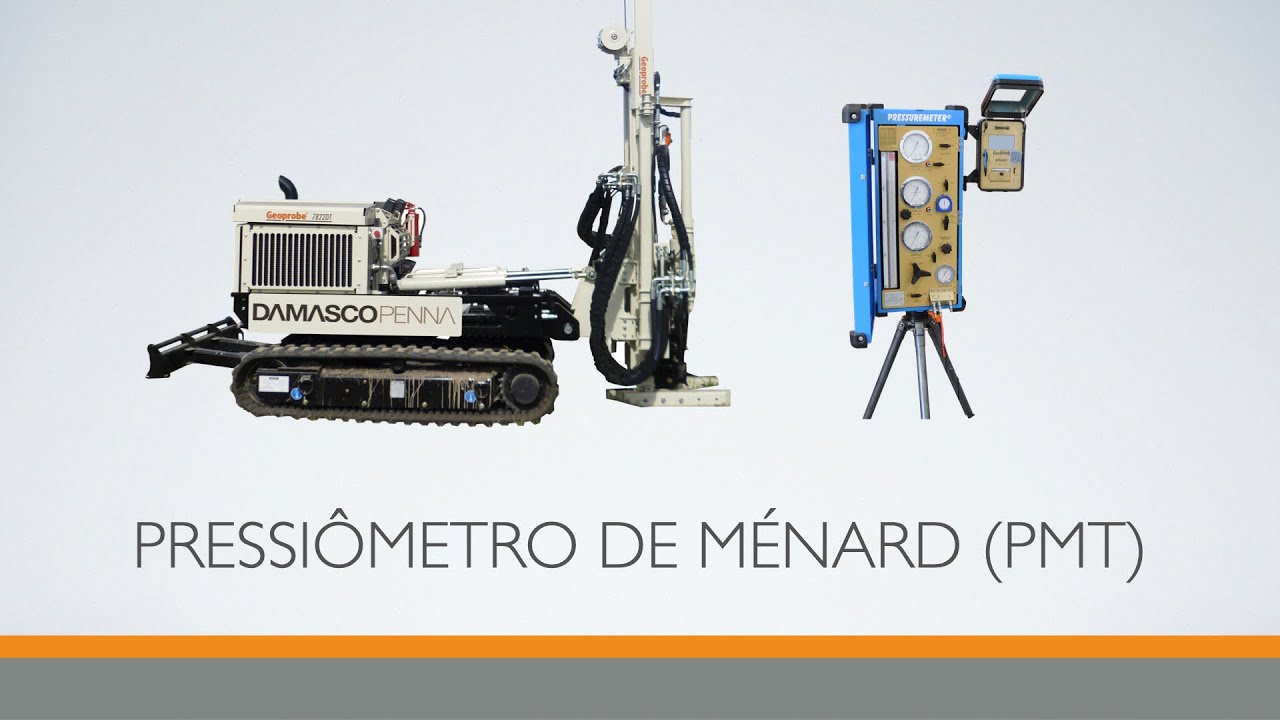
According to ISO-22.476-4 · ASTM D4719
The test is standardized by ISO 22476-4 and ASTM D4719. It provides quantities measured directly at the test depth:
| Pressuremeter modulus | Ménard pressuremeter modulus (EM), the in situ soil stiffness |
|---|---|
| Creep pressure | Creep pressure, marking the transition in soil behavior |
| Limit pressure | Ménard limit pressure (pL), the soil resistance to cavity expansion |
Through correlations, the results allow the assessment of:
| Deformability | Soil modulus of elasticity (E) |
|---|---|
| Saturated clays | Undrained shear strength (Su) |
| Sandy soils | Effective friction angle (ø) |
| Foundations | Bearing capacity and settlement of shallow and deep foundations |
| Pressuremeter profile | Pressure-volume curves and EM and pL values by depth |
| Derived parameters | Modulus E, Su, friction angle and bearing capacity and settlement, when interpretation is contracted |
| Report | Report with the curves, the pressure and volume records and the calculation notes |
| Typical lead time | According to depth and number of verticals |
Performed to the same QA/QC, safety and site standard as every Damasco Penna service, described in Quality and field operations.
Frequently asked questions about the Ménard Pressuremeter
What is the Ménard Pressuremeter used for?
The test measures the strength, the stiffness and the in situ stresses of the soil. It provides the Ménard pressuremeter modulus, the creep pressure and the limit pressure, obtained from the pressure-strain relationship recorded during the expansion of the probe.
What is the Ménard limit pressure?
The limit pressure (pL) is the pressure associated with the limit of cavity expansion, when the soil around the probe reaches failure. It is one of the main results of the test and is the basis for calculating the bearing capacity of foundations in the French method.
How does the PMT differ from the CPTu and the DMT?
The CPTu and the DMT are pushed into the ground and measure almost continuously; the PMT is run in a pre-bored hole, point by point, and measures the pressure-strain relationship and the limit pressure directly, the basis of the French foundation method. The methods complement one another.
Where is the PMT most used?
It is the main form of geotechnical investigation in France and is applied in the design of shallow and deep foundations, with well-established correlations for bearing capacity and settlement.
Related services
Ménard Pressuremeter for your project
Tell us the project context and we will put together the investigation plan and the quote.