
Principle and application
The field vane test determines the undrained shear strength (Su) of saturated clayey soils in the in situ condition. A cruciform vane, with a height of about twice its diameter, is pushed into the ground and subjected to the torque required to shear the surrounding soil by rotation.
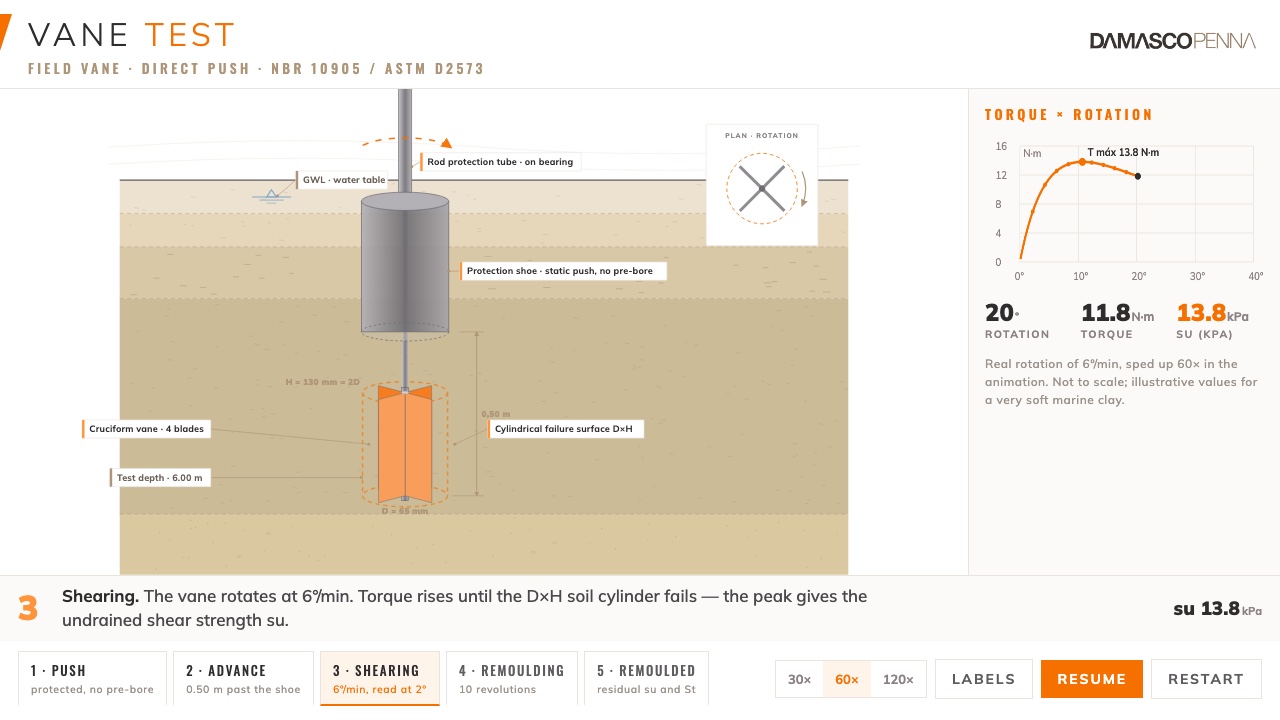
Damasco Penna runs the type A test of the Brazilian standard (ABNT NBR 10905): the vane is statically pushed from the ground surface. Just before the test depth, insertion is stopped and a set of inner rods advances the vane 0.5 m below the string, where the test is carried out in minimally disturbed soil.
Typical applications: embankments over soft soil, dams and dykes, tailings dams, ports, nearshore and dredging, roads over coastal floodplains and slope stability in clay.
The test in motion
Interactive animation of the type A vane test (NBR 10905): the cruciform vane is pushed protected by the shoe, advances 0.5 m into intact soil and rotates at 6°/min until the soil cylinder fails. Follow the torque × rotation curve, the peak that gives the undrained shear strength Su and the remoulded reading that yields the sensitivity St.
Execution and readings
Rotation is driven by an electric motor with torque capacity up to 100 N·m at a precise rate of 0.1°/s, and dedicated software plots the torque × rotation curve in real time. Because the test needs minimally disturbed soil, drilling with hollow-stem augers (hollow auger) is usually the best way to reach the test depth. Damasco Penna operates equipment from the Dutch brands AP van den Berg and Geomil.
Vane insertion
The cruciform vane, with four blades at a height-to-diameter ratio of 2:1, is pushed from the bottom of the borehole down to the test depth, without rotation.
Torque to failure
Rotation is applied at a standard angular rate and the peak torque is measured. From that peak the undrained peak strength (Su) is calculated.
Remoulding and residual reading
After failure, the vane is rotated rapidly to remould the soil and the residual torque, the remoulded strength, is measured.
Sensitivity and profile
The ratio between peak and remoulded strength defines the sensitivity (St). Repeating the test at several depths yields the Su profile with depth.
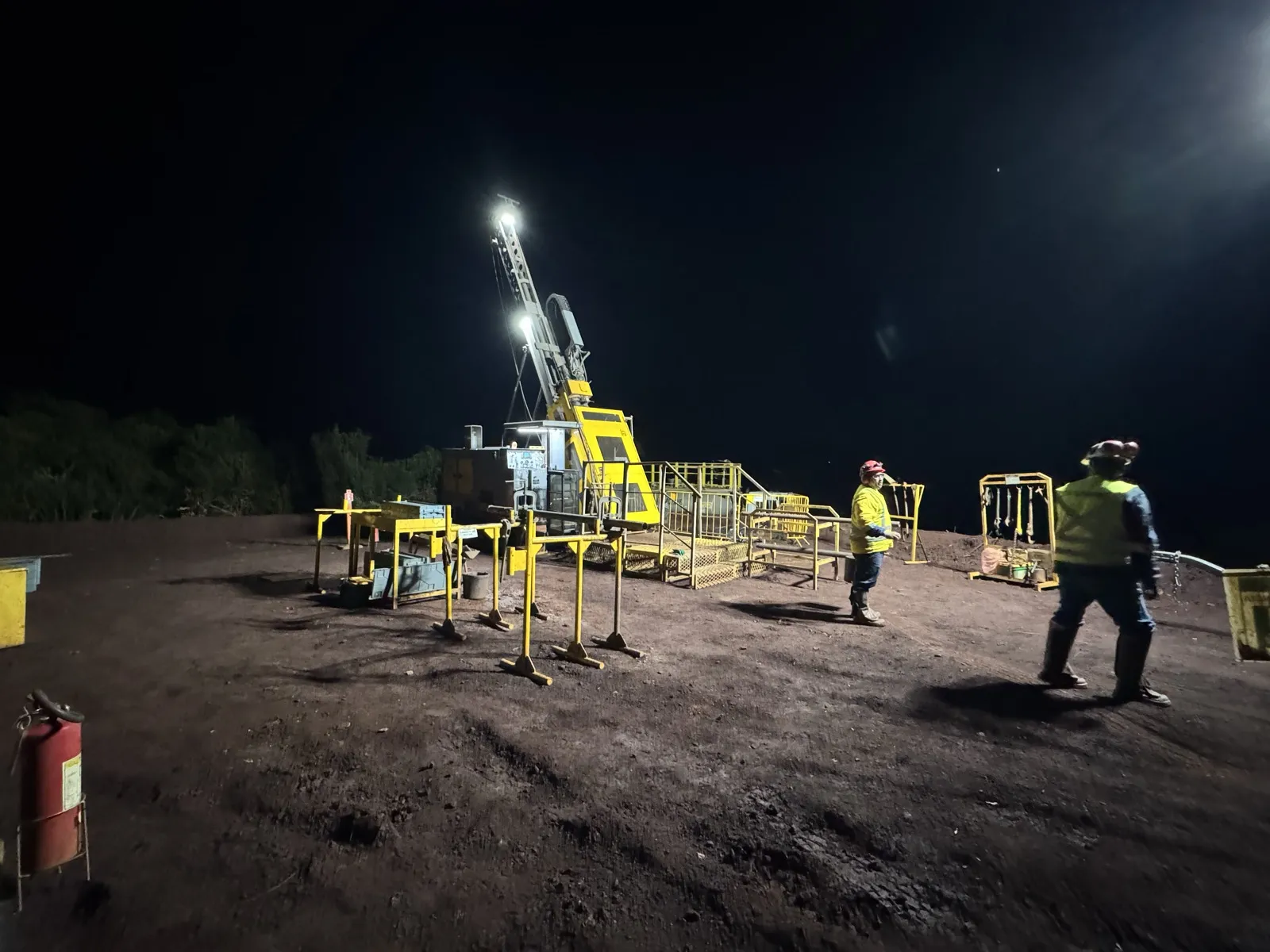
Quality controls: calibrated vane and torque meter, with periodic verification and traceable certificates, rod friction correction, so the torque from the string is not attributed to the soil, test depth below the zone disturbed by insertion, with hollow-auger drilling that reduces remoulding, standardised rotation rate and controlled test timing, log reviewed by a geotechnical engineer before delivery, a process within the ISO system and ready for high-demand environments: mining, industry and ports.
In accordance with NBR 10905
| Standard | ABNT NBR 10905 (type A test); international references ASTM D2573 and ISO 22476-9 |
|---|---|
| Peak strength | Intact Su, calculated from the peak torque |
| Remoulded strength | Residual Su, measured after ten revolutions of the vane |
| Sensitivity | St, ratio between peak and remoulded strength |
| Design correction | Bjerrum factor (μ) as a function of the plasticity index, for stability analysis |
| Field log | Peak and remoulded Su by depth, with the strength profile versus depth |
| Sensitivity | St calculated for each point tested |
| Design parameters | Su corrected by the Bjerrum factor, when interpretation is contracted |
| Charts and raw data | Torque × rotation graphs and raw torque readings available on request |
| Typical turnaround | Preliminary log the same day; report according to scope |
Performed to the same QA/QC, safety and site standard as every Damasco Penna service, described in Quality and field operations.
Frequently asked questions about the Field vane test
What does the vane test measure?
It measures the undrained shear strength (Su) of the clay directly in the ground, both in the intact state and after remoulding. With the two readings it also yields the sensitivity (St) of the soil.
Does the vane test replace the CPTu?
It does not replace it, it complements it. The CPTu gives the continuous subsoil profile; the vane test gives a direct measure of Su, useful to calibrate piezocone correlations and to check critical points in the soft layer.
In which soils does the test apply?
It is suited to soft to medium, saturated clays. It does not apply to soils with sand, gravel or material that allows drainage during rotation, situations in which the undrained assumption no longer holds.
Why does the vane Su need to be corrected?
For use in stability analysis, the measured Su is adjusted by the Bjerrum factor, which depends on the plasticity index of the clay. The correction avoids overestimating the strength available in design.
Related services
Field Vane Test for your project
Tell us the project context, we will put together the investigation plan and the quote.