
Principle and application
The downhole test measures the velocity of seismic waves along a single borehole, following ASTM D7400/D7400M. The source stays at the surface: a loaded wooden plank, struck horizontally with a sledgehammer, generates the shear wave; a triaxial geophone clamped against the borehole wall records the arrival at each depth. From the travel time, corrected to the vertical, come the Vs and Vp profiles and the small-strain shear modulus (G0 = ρ·Vs²).
Because it uses a single borehole, it is the most economical alternative to the crosshole test whenever the project needs dynamic stiffness measured at depth, while keeping accuracy higher than that of surface methods. It shares its measuring principle with the seismic dilatometer SDMT and the seismic piezocone.
Typical applications: seismic site response and site classification, foundations of vibrating machinery, dams and tailings dams, liquefaction assessment and dynamic analysis of structures.
The test in motion
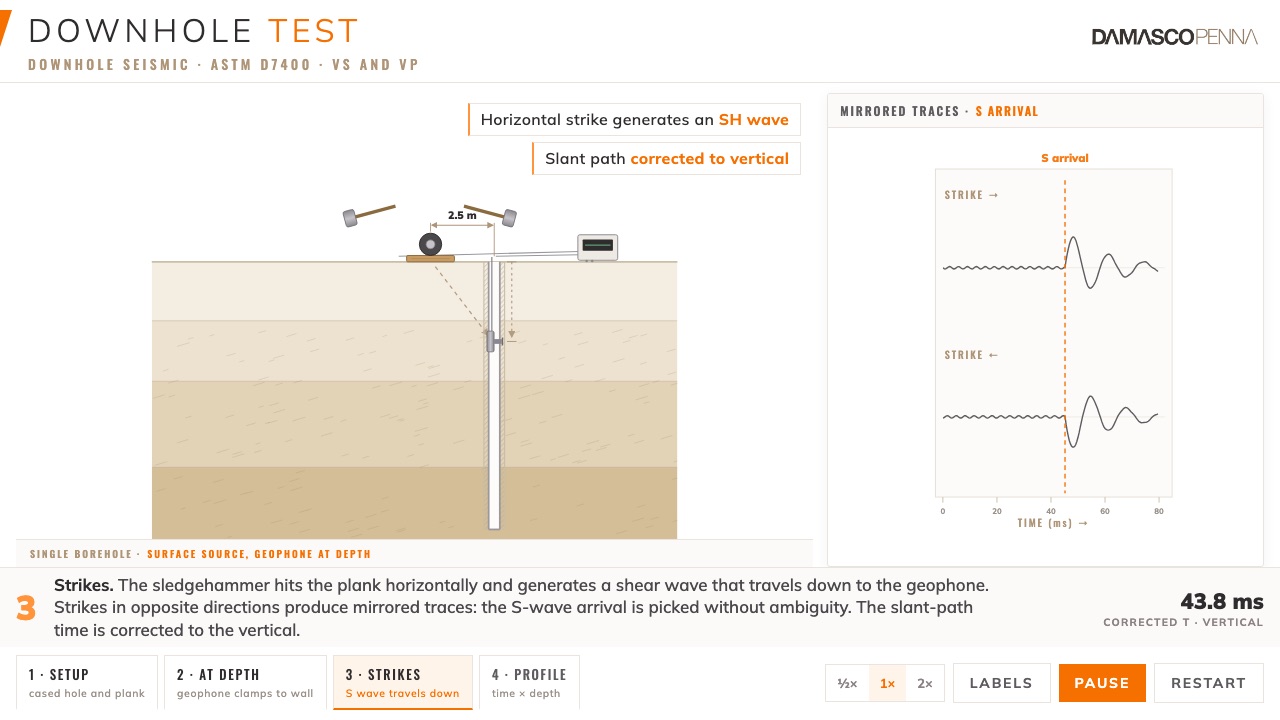
The horizontal blow on the plank, the shear wave travelling down to the geophone and the travel-time versus depth curve taking shape. The animation walks through the four stages of the test, with the mirrored traces that mark the S-wave arrival.
The test in stages
Borehole prepared
The borehole receives PVC casing grouted to the ground; the shear plank is positioned and loaded a few metres from the borehole mouth.
Geophone at depth
The triaxial geophone is lowered to the test depth and its clamping arm presses it against the casing wall, ensuring proper coupling.
Blows and record
The sledgehammer strikes the plank horizontally, with a synchronised trigger. Blows in opposite directions produce mirrored traces that mark the S-wave arrival; the slant-path time is corrected to the vertical travel time.
Curve and profile
The measurement is repeated every 1.0 to 1.5 m. The travel-time versus depth curve gives the interval velocity of each stretch and, from it, the Vs and Vp profiles and the dynamic moduli.
Quality controls: casing grouted to the ground for proper coupling, source-to-borehole distance measured and used in the geometric correction, reversible-polarity source with synchronised trigger, triaxial geophone clamped against the wall and interpretation by a geophysics specialist.
To ASTM D7400/D7400M
The figure shows the ASTM D7400 geometry, with the slant travel path corrected to vertical time, and alongside the time versus depth curve and the resulting Vs profile.
Downhole test layout: plank a few metres from the borehole mouth, triaxial geophone clamped every 1.0 to 1.5 m and geometric correction of the travel time. Illustrative values.
| Standard | ASTM D7400/D7400M (downhole seismic testing) |
|---|---|
| Layout | One cased, grouted borehole; shear source at the surface, a few metres from the mouth |
| Vs | Shear-wave velocity, per depth interval |
| Vp | Compression-wave velocity, per depth interval |
| Dynamic moduli | G0 = ρ·Vs², E0 and dynamic Poisson's ratio (from the Vp/Vs ratio) |
| Geometric correction | Slant-path time corrected to the equivalent vertical time |
| Report | Methodology, travel-time versus depth curve, Vs and Vp profiles and moduli |
| Typical lead time | According to depth and number of boreholes |
Performed to the same QA/QC, safety and site standard as every Damasco Penna service, described in Quality and field operations.
Frequently asked questions about the Downhole Test
What is the downhole test used for?
To measure the profile of seismic wave velocities (Vs and Vp) at depth using a single borehole, obtaining the small-strain shear modulus (G0) that dynamic analysis and seismic design require.
What is the difference between downhole and crosshole?
In the downhole test the source stays at the surface and the wave travels down to a geophone inside the borehole; one borehole is enough. In the crosshole test, source and geophones sit in neighbouring boreholes at the same depth and the wave travels horizontally; two or three boreholes are needed, with higher accuracy per layer. Downhole is the middle ground between crosshole and surface methods such as MASW.
Do downhole and SDMT measure the same thing?
The seismic principle is the same: a surface source and receivers at depth measuring the S-wave arrival time. In the SDMT the geophones sit in the dilatometer blade itself, which is pushed into the ground; in the downhole test the geophone travels down a cased borehole, which allows testing ground that cannot be pushed into and reaching greater depths.
Why are the blows struck in opposite directions?
Reversing the direction of the blow on the plank reverses the polarity of the shear wave, so the two recorded traces are mirror images. The point where they split marks the S-wave arrival without ambiguity, separating it from the P-wave and from noise.
Related services
Downhole test for your project
Tell us about your project and we will put together the investigation plan and the quote.