
Principle and application
The undisturbed block sample is hand-carved from the wall or floor of an inspection pit or trench, in accordance with NBR 9604. With no driving and no rotation, it is the method that least disturbs the soil: structure, moisture, cementation and orientation reach the laboratory as they were in the ground. That is why the block is the benchmark of quality among undisturbed samples.
It is the right choice when the test demands the best possible material: peak strength of structured soils, behaviour of residual and collapsible soils, shear along defined planes. The limitation is depth: hand recovery depends on access to the pit and on cohesive soil above the water table.
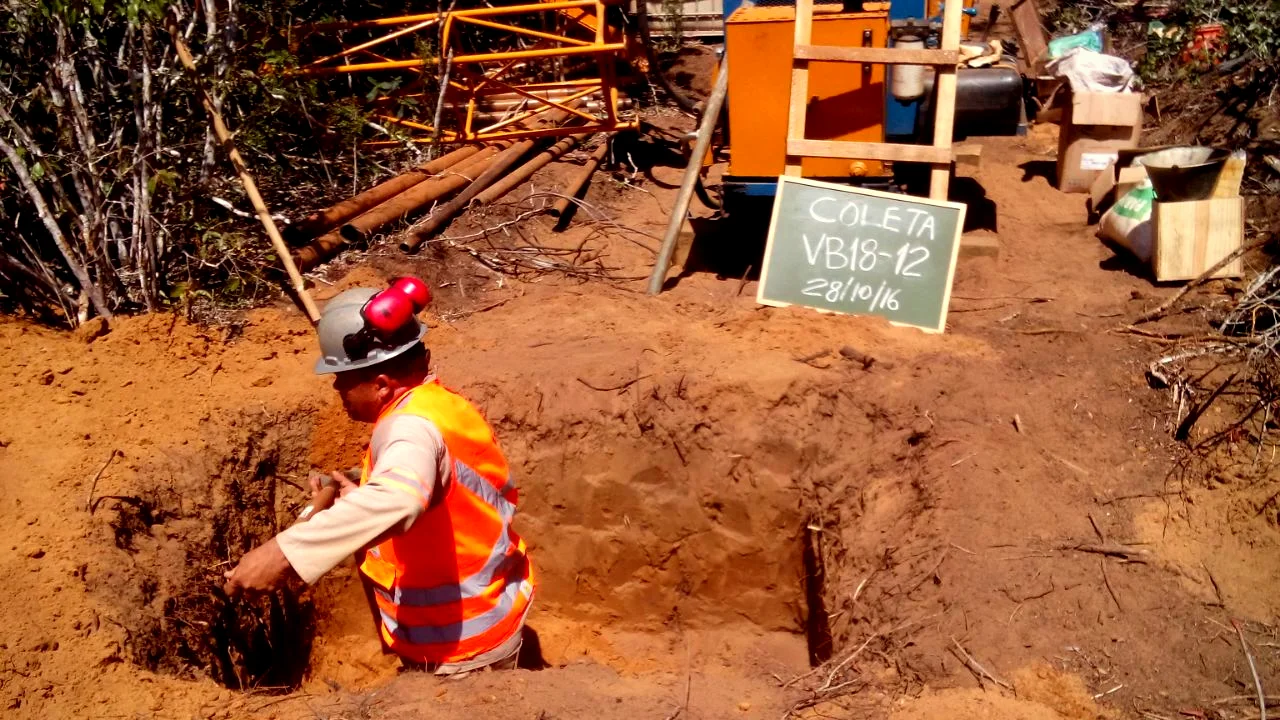
Typical applications: residual soils, collapsible soils, dams, special foundations and research and advanced testing.
Recovery in stages
Opening the pit
Inspection pit or trench excavated to the sampling elevation, with shoring and a safety procedure, in accordance with NBR 9604.
Carving the block
The block is sculpted with hand tools into a pedestal, to the dimensions the test requires, with no blows and no vibration.
Protection and labelling
Successive layers of cloth and paraffin seal the block. Top and orientation are marked, and the set goes into a rigid box with cushioning material.
Transport
Moved without vibration and with moisture preserved to the laboratory, with traceability of pit, elevation and orientation.
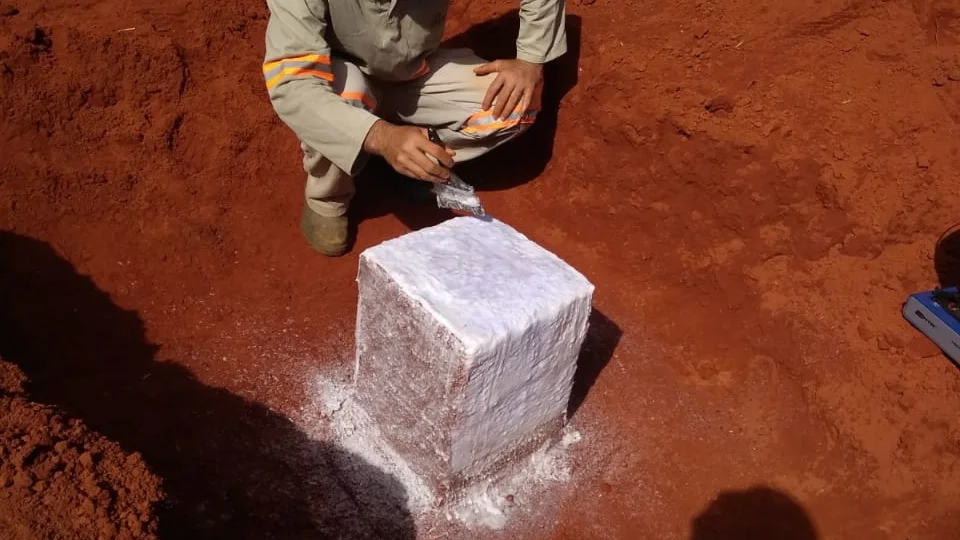
Quality controls: immediate paraffin coating, layer by layer, to preserve moisture, block top and orientation marked before removal, rigid box with cushioning and vibration-free transport, traceability by pit, elevation and orientation to the laboratory and shored pit with an HSE procedure for excavation work.
In accordance with NBR 9604
| Sample | Undisturbed block, dimensions defined by the test |
|---|---|
| Recovery | By hand, in an inspection pit or trench, or from a bench |
| Condition | Cohesive soils, above the water table |
| References | NBR 9604 · ASTM D7015 (block samples) |
| Undisturbed blocks | Paraffin-sealed, boxed and labelled by pit, elevation and orientation |
| Record | Log with pit sketch, depth and recovery condition |
| Forwarding | Straight to the soil laboratory, when integrated |
| Typical lead time | According to the field campaign |
Performed to the same QA/QC, safety and site standard as every Damasco Penna service, described in Quality and field operations.
Frequently asked questions about block sampling
When is a block sample worth it?
When the project demands the best possible sample: structured or cemented soils whose peak strength is lost with any remoulding, residual and collapsible soils, and shear tests along defined planes. In those cases, hand carving preserves what driving a sampler would alter.
Block, Shelby or Denison?
The block delivers the highest quality, but depends on an inspection pit: limited depth and cohesive soil above the water table. Shelby (soft soils) and Denison (stiff soils) reach any depth through the borehole. The technical team combines the methods according to the profile and the test.
Why does the block preserve the sample orientation?
Because the top and direction of the block are marked before removal. This lets the laboratory test the soil along the same planes in which it works in the ground, which matters in anisotropic soils and on defined shear surfaces.
Related services
Block sampling for your project
Tell us about your project and we will prepare the investigation plan and the quote.