
Principle and application
The crosshole test measures the velocity of seismic waves travelling horizontally between neighbouring boreholes, following ASTM D4428/D4428M. A source is lowered into one borehole and triaxial geophones into the adjacent ones, all at the same depth: from the borehole spacing and the travel time come the shear-wave velocity (Vs) and the compression-wave velocity (Vp), layer by layer. From Vs comes the small-strain shear modulus (G0 = ρ·Vs²), the stiffness parameter that dynamic analysis requires, with accuracy higher than that of surface methods.
Because the travel path is short and horizontal, the crosshole test resolves thin layers that surface methods cannot see, including softer layers beneath stiff ones.
Typical applications: seismic site response and site classification, foundations of vibrating machinery, dams and tailings dams, liquefaction assessment, soil-structure interaction and vibration studies for metro lines and industry.
The test in motion
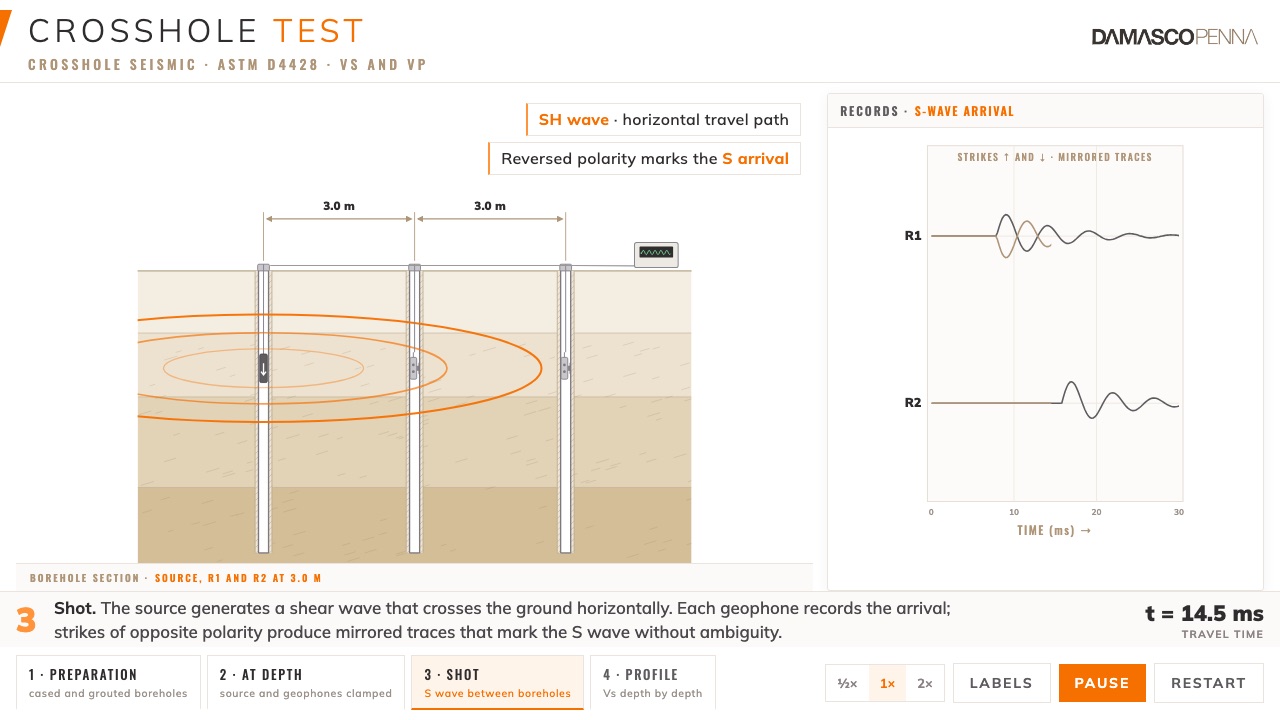
Source and geophones at the same depth, the trigger, and the shear wave crossing the ground between the boreholes. The animation shows borehole preparation, the deviation survey, reversed-polarity records and the build-up of the Vs profile.
The test in stages
Boreholes prepared
Two or three aligned boreholes, about 3 m apart, receive PVC casing grouted to the ground: the grout coupling is what guarantees a clean signal.
Geometry corrected
A verticality probe runs down each borehole and measures its deviation with depth; the true distances between boreholes are computed at every test depth, as ASTM D4428 requires.
Trigger at depth
The shear source and the triaxial geophones, clamped against the casing wall at the same depth, record the wave travel. Blows of opposite polarity produce mirrored traces that mark the S-wave arrival without ambiguity.
Profile and moduli
The measurement is repeated depth by depth. From Vs = corrected distance ÷ travel time come the Vs and Vp profiles and the dynamic moduli G0, E0 and Poisson's ratio.
Quality controls: casing grouted to the ground for proper coupling, deviation survey of every borehole with distance corrections at each depth, reversible-polarity source with synchronised trigger, triaxial geophones clamped against the wall and interpretation by a geophysics specialist.
To ASTM D4428/D4428M
The figure shows the geometry prescribed by ASTM D4428 and, alongside, how the result is presented: the opposite-polarity traces that mark the S-wave arrival and the Vs profile layer by layer.
Crosshole test layout: source and receivers at the same depth, boreholes about 3 m apart and distances corrected by the deviation survey. Illustrative Vs values.
| Standard | ASTM D4428/D4428M (crosshole seismic testing) |
|---|---|
| Layout | Two or three aligned boreholes, about 3 m apart, cased and grouted |
| Vs | Shear-wave velocity, at each depth |
| Vp | Compression-wave velocity, at each depth |
| Dynamic moduli | G0 = ρ·Vs², E0 and dynamic Poisson's ratio (from the Vp/Vs ratio) |
| Geometric correction | Borehole spacing corrected by the deviation survey |
| Report | Methodology, Vs and Vp profiles and moduli by depth |
| Typical lead time | According to the number of boreholes and depth |
Performed to the same QA/QC, safety and site standard as every Damasco Penna service, described in Quality and field operations.
Frequently asked questions about the Crosshole Test
What is the Crosshole test used for?
The crosshole test measures the velocity of seismic waves propagated between boreholes, obtaining the small-strain shear modulus of the soil (G0). This is the dynamic stiffness parameter required by seismic design and the foundations of vibrating machinery, with accuracy higher than that of surface methods.
Crosshole, downhole and MASW, what is the difference?
All of them measure wave velocity. Crosshole measures between boreholes (most accurate); downhole measures along a single borehole; MASW measures from the surface (no borehole). The choice balances accuracy, cost and access.
What is the G0 modulus used for?
It is the small-strain stiffness of the soil, the basis for dynamic analysis: seismic response of the ground and foundations for vibrating equipment.
Why does Vs matter more than Vp below the water table?
Below the water table the compression wave travels through the pore water and Vp tends to stay close to 1,500 m/s, reflecting the fluid rather than the soil skeleton. The shear wave does not propagate through water: Vs keeps reading the stiffness of the solid skeleton, which is why it is the key parameter of the test.
How many boreholes does the test require?
ASTM D4428 accepts a two-borehole layout and recommends three in line, about 3 m apart. With three boreholes the velocity comes from the interval between the two receivers, which removes the trigger-system delay and improves accuracy.
Related services
Crosshole test for your project
Tell us about your project and we will prepare the investigation plan and the quote.