
Principle and application
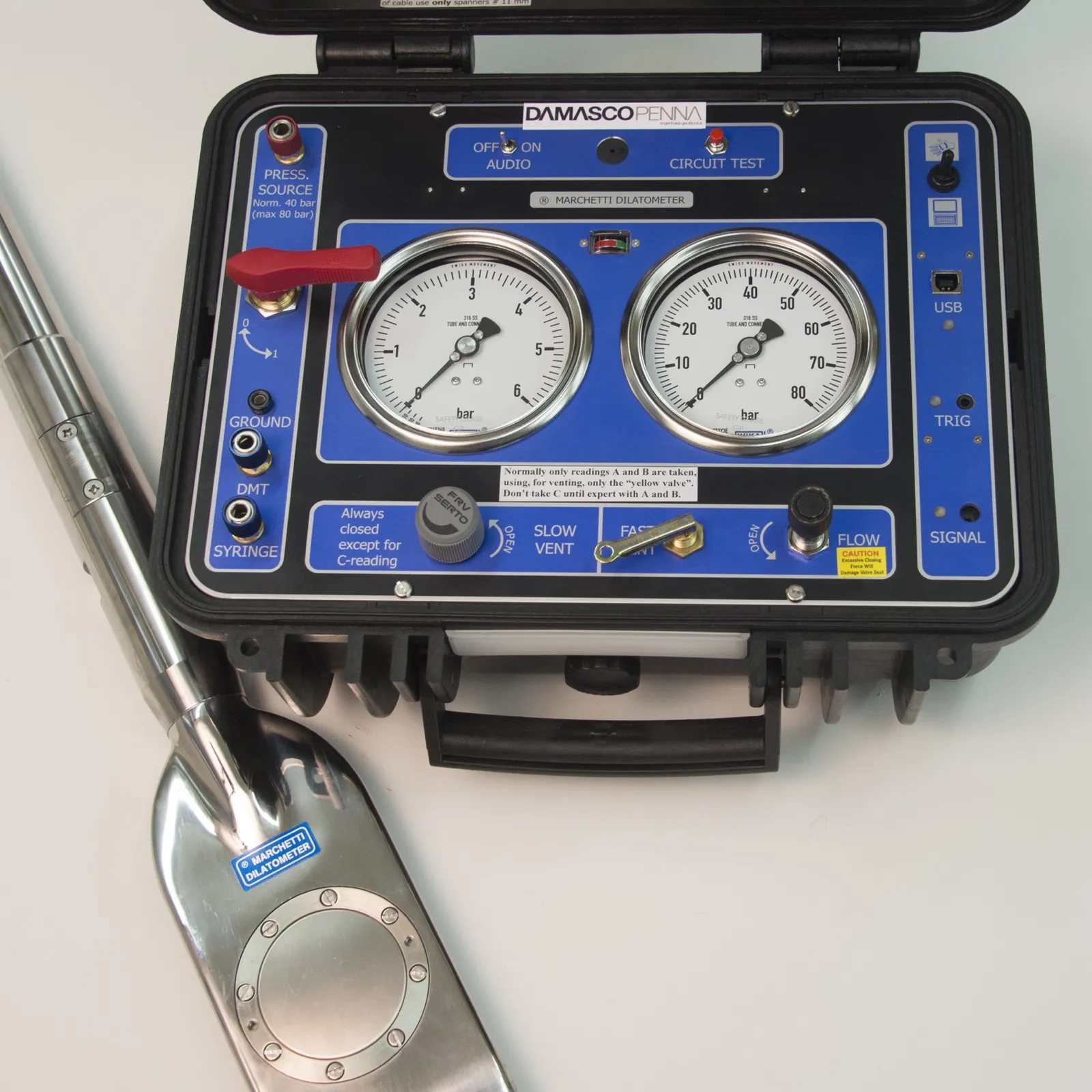
The Marchetti dilatometer (DMT) measures in situ soil stiffness by driving a flat blade fitted with a metal membrane into the ground, expanded with gas every 20 cm. The readings yield the Marchetti indices, notably the deformation modulus and the stress history, which govern settlement prediction; in the seismic version (SDMT) it also measures the shear wave velocity.
Used in more than 40 countries and worldwide since 1975, the DMT (Flat Dilatometer Test) is regarded as one of the most accurate in situ testing tools for settlement prediction and for estimating the modulus of elasticity (E) of the investigated layers. Quick and simple to run, it applies to practically every soil type, in accordance with ASTM D6635 and ISO-22.476-11.
At each 20 cm pause in penetration, nitrogen gas is injected to expand the metal membrane of the tip against the ground. Two readings are taken on a precision gauge: pressure A, when the membrane overcomes the ground, and pressure B, when it deforms the soil by 1.1 mm. Through correlations these give the coefficient of earth pressure at rest (K0), the modulus of elasticity (E), the undrained shear strength of clays (Su), the friction angle of sands, the grain-size classification and the OCR.
The test, step by step
Blade penetration
The stainless steel wedge-shaped blade, fitted with a circular membrane, is advanced by a hydraulic rig through metal rods.
Nitrogen expansion
Every 20 cm penetration is halted and nitrogen is injected. Reading A (the membrane lifts off the soil) and Reading B (a 1.1 mm deflection) are recorded.
Correction and pressures
The ΔA and ΔB measurements, taken out of the ground, remove the membrane's own stiffness. Once corrected, the readings yield the pressures p0 and p1.
Seismic module (SDMT)
In the seismic version, two geophones spaced 50 cm apart measure the shear wave velocity Vs and the small-strain modulus G0.
The test in the field

In accordance with ASTM D6635 and Eurocode 7
| Reference standard | ASTM D6635 and Eurocode 7 (EN 1997) |
|---|---|
| Material index (Id) | Soil type, from clay to sand |
| Horizontal stress index (Kd) | Stress state and Ko estimate |
| Dilatometer modulus (Ed) | Stiffness and deformation modulus |
| Pore pressure (Ud) | Hydraulic conditions of the layer |
| Marchetti correlations (1980) | Ko, E, OCR, Su in clays and φ in sands |
| Shear wave (SDMT) | Velocity Vs and small-strain modulus G0 |
The deliverable
| DMT profile | A and B readings and corrected pressures p0 and p1 versus depth |
|---|---|
| Indices | Id, Kd, Ed and Ud every 20 cm |
| Parameters | Ko, E, OCR, Su and φ derived from the Marchetti correlations |
| Vs profile (SDMT) | Shear wave velocity and G0, when seismic |
| Typical turnaround | According to depth and number of soundings |
Sectors and project types
Frequently asked questions about the Marchetti Dilatometer
What is the DMT test for?
The Marchetti dilatometer (DMT) measures in situ soil stiffness by driving a flat blade fitted with a metal membrane into the ground, expanded with gas every 20 cm. The readings yield the Marchetti indices, notably the deformation modulus and the stress history, which govern settlement prediction; in the seismic version (SDMT) it also measures the shear wave velocity.
What is the advantage of the DMT over the SPT?
The DMT measures stiffness directly and repeatably, which the SPT does not. For settlement prediction and for soft soils, the DMT (and the SDMT) provide far more reliable parameters.
What does the seismic version (SDMT) add?
In addition to the Marchetti indices, the SDMT measures the shear wave velocity Vs, essential for the dynamic modulus and for studies of the ground's seismic response.
Do the DMT and the CPTu complement each other?
Yes. The CPTu is strong on stratigraphy and strength; the DMT is strong on stiffness and stress history. Together they complete the parameter set.
Related services
Marchetti Dilatometer for your project
Tell us the project context, we will put together the investigation plan and the quote.