
Principle and application
Settlement is a stiffness problem, not only a strength one. The DMT measures soil deformability directly and repeatably, feeding settlement prediction with reliable parameters.
Typical applications: embankments over soft soil, dams, port works, large foundations and seismic analysis.
The test in stages
Blade penetration
The dilatometer blade is pushed into the ground using the same reaction as the CPTu.
Membrane expansion
The steel membrane is expanded with gas and the A and B pressures are recorded.
Reading by depth
The step is repeated every 20 cm, building the profile of the Marchetti indices.
Seismic modulus (SDMT)
In the seismic version, the shear wave velocity Vs is also measured.
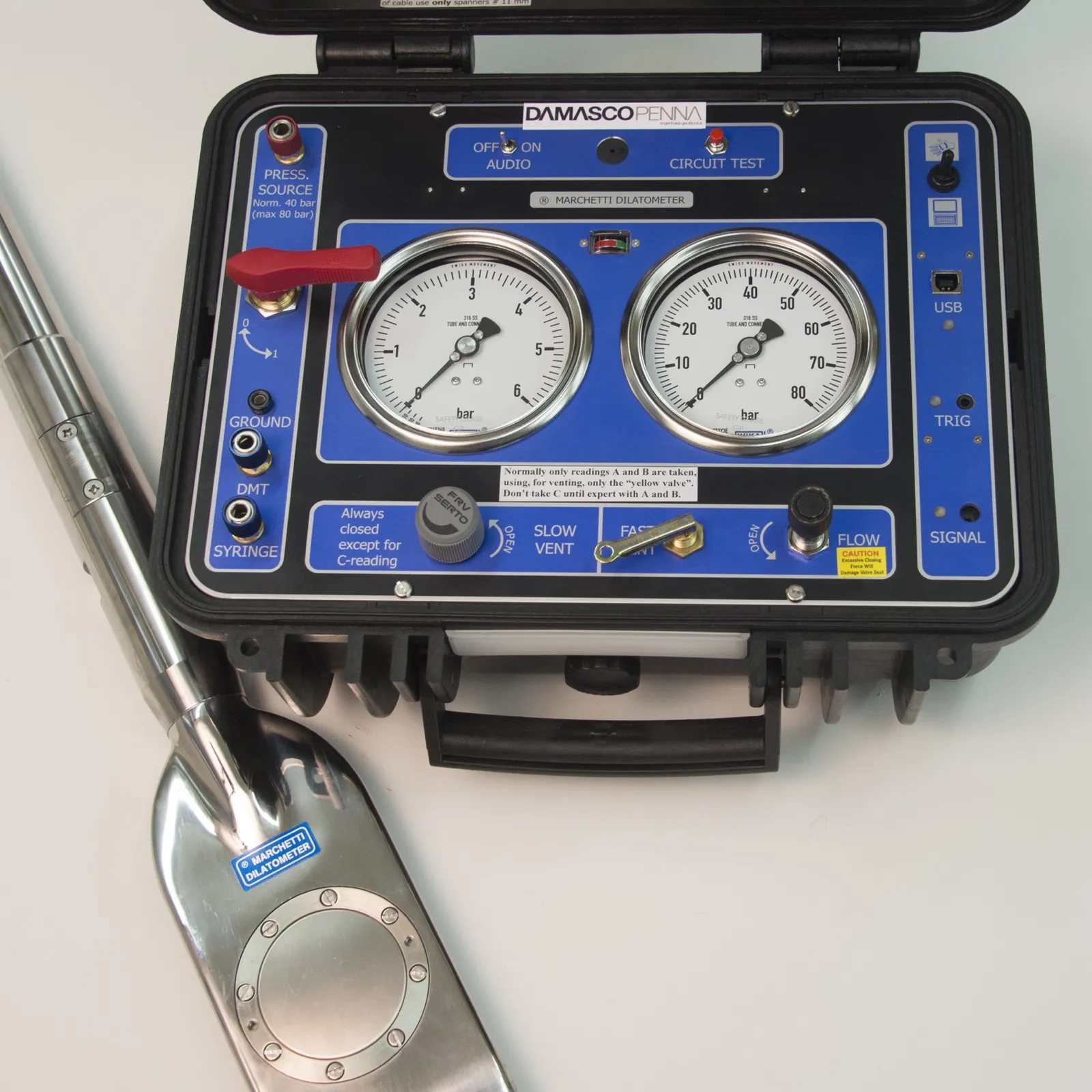
Quality controls: membrane calibration before and after each vertical, procedure following the established Marchetti practice, digital acquisition and consistency check of the indices and interpretation by a geotechnical engineer.
The test in the field

According to Marchetti
| Stiffness | Dilatometer modulus and constrained modulus |
|---|---|
| Horizontal stress | KD index and K0 estimate |
| History | Overconsolidation ratio (OCR) |
| S wave (SDMT) | Vs velocity and shear modulus G0 |
| DMT profile | ID, KD, ED indices by depth |
| Parameters | Derived modulus, OCR, K0 and Su |
| Vs profile (SDMT) | Shear wave velocity, when seismic |
| Typical lead time | Depending on depth and number of verticals |
Performed to the same QA/QC, safety and site standard as every Damasco Penna service, described in Quality and field operations.
Frequently asked questions about the Marchetti Dilatometer
What is the Marchetti dilatometer for?
Settlement is a stiffness problem, not only a strength one. The DMT measures soil deformability directly and repeatably, feeding settlement prediction with reliable parameters.
What is the advantage of the DMT over the SPT?
The DMT measures stiffness directly and repeatably, which the SPT does not. For settlement prediction and for soft soils, the DMT (and the SDMT) provide far more reliable parameters.
What does the seismic version (SDMT) add?
Besides the Marchetti indices, the SDMT measures the shear wave velocity Vs, essential for the dynamic modulus and for studies of the ground seismic response.
Do the DMT and the CPTu complement each other?
Yes. The CPTu is strong on stratigraphy and strength; the DMT is strong on stiffness and stress history. Together they complete the parameter picture.
Marchetti Dilatometer for your project
Tell us the project context and we will put together the investigation plan and the quote.