
Principle and application
Measures the soil's bearing capacity for pavement design.
The California Bearing Ratio (CBR) expresses the soil's resistance to the penetration of a standardized piston, compared with that of a reference crushed stone. The result, as a percentage, is the parameter that pavement design uses to size the thickness of the sub-base, base and subgrade reinforcement layers. The higher the CBR, the greater the bearing capacity of the layer and the smaller the required thickness.
The specimen is compacted at the design energy and soaked in water for four days, also measuring the swelling of the soil, a critical value for clayey subgrade materials. Part of the Soil Testing Laboratory area, it complements Proctor Compaction, which defines the density at which the CBR is tested.
The test in motion
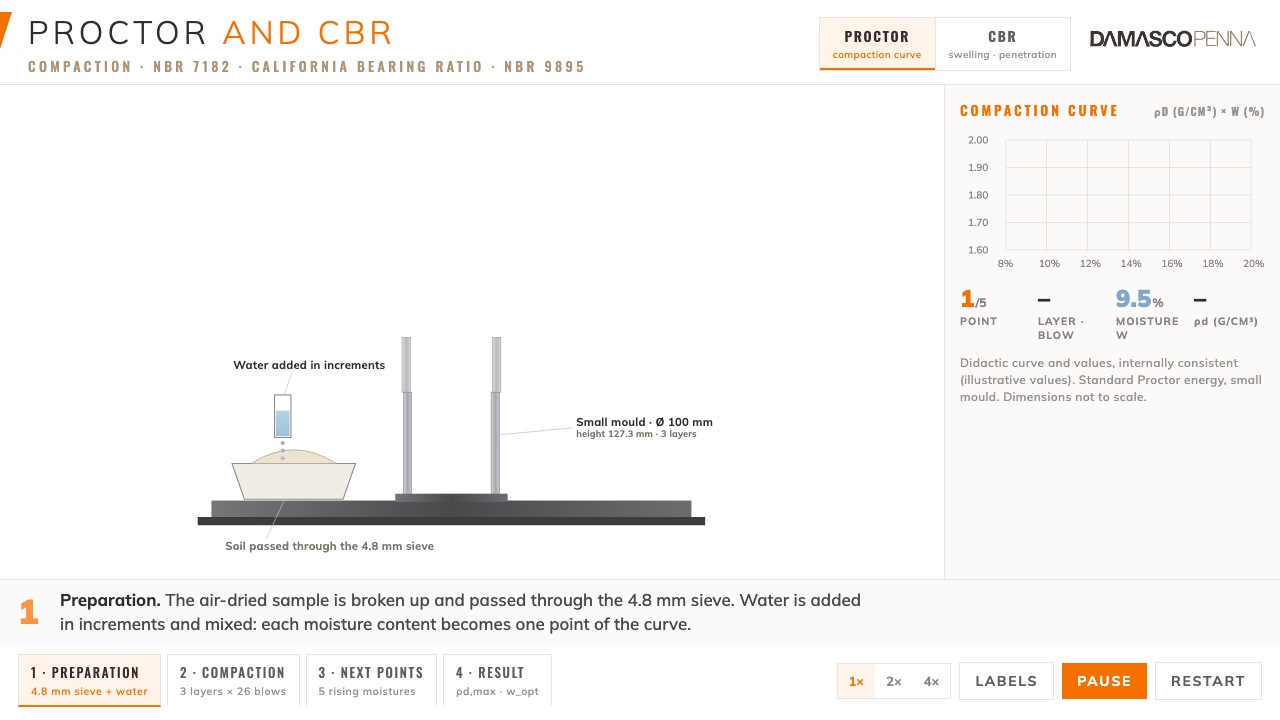
Interactive animation of the California Bearing Ratio: the compacted specimen is soaked to measure swelling and then penetrated by the standard piston, producing the pressure versus penetration curve that defines the CBR. A selector switches to the Proctor compaction test that prepares the specimen.
The test in steps
Compaction
The soil is compacted in a cylindrical mold at the optimum moisture content and the energy defined by the design Proctor.
Soaking
The specimen is soaked in water for four days, with daily measurement of swelling under a standard surcharge.
Penetration
A piston penetrates the soil at a controlled rate, recording the load at 2.54 mm and 5.08 mm of penetration.
Bearing ratio
The measured load is compared with that of the standard crushed stone, giving the CBR as a percentage and the swelling of the material.
To NBR 9895
| Reference | NBR 9895 (California Bearing Ratio); ASTM D1883; DNIT-ME 049 |
|---|---|
| Result | CBR as a percentage and soil swelling on soaking |
| Condition | Specimen soaked for four days, at the design energy |
| Use | Sizing of sub-base, base and subgrade reinforcement |
| CBR | Bearing ratio, as a percentage, at the design energy |
| Swelling | Soil swelling on soaking, critical for clayey subgrade |
| Curve | Load-penetration curve of the test |
| Report | Sample identification, energy and reference standard |
Quality controls: test performed to NBR 9895 with calibrated press and piston, laboratory guided by ABNT, ASTM and ISO/IEC 17025 requirements, samples identified and tracked from site to report and mobile earthworks laboratories on site when the project demands fast turnaround.
Performed to the same QA/QC, safety and site standard as every Damasco Penna service, described in Quality and field operations.
Sectors and project types
Frequently asked questions about CBR
What is the CBR test used for?
The CBR measures the bearing capacity of a soil for pavement design. The result, as a percentage, indicates how much the soil resists penetration compared to a reference crushed stone, and it is the parameter that defines the thickness of the sub-base, base and subgrade reinforcement layers in road design.
What does the CBR percentage value mean?
It is the ratio between the load the soil bears and the load a standard crushed stone would bear at the same penetration. A CBR of 100% equals the reference crushed stone. Subgrade soils usually have a low CBR, and the more demanding pavement layers require higher values.
Why is the specimen soaked in water?
Soaking for four days simulates the most unfavorable in-service condition of the soil, saturated, and allows the swelling of the material to be measured. This swelling is a critical value for clayey subgrades, because a soil that swells too much compromises the pavement even with an apparently adequate CBR.
Other services in this area
CBR test for your project
Tell us about your project and we will put together the testing program and the quote.