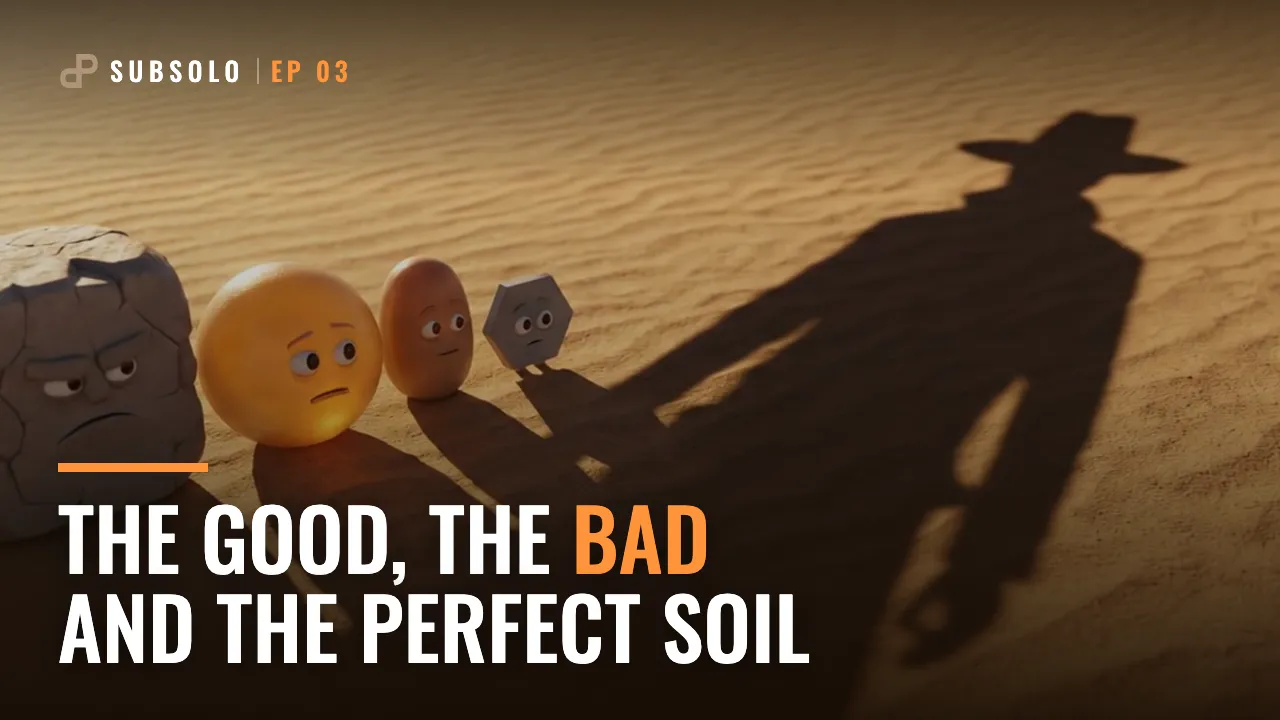
A thirty-storey building settles a few centimetres, yet the soil grain does not deform and water does not compress. The episode chases the real culprit, the empty space between the grains, and shows why the perfect soil, which would be rock, is exactly what nobody wants to excavate.
Prefer reading? The full transcript is just below. The timestamps jump to the exact moment in the video. Narration and subtitles in English.
In three points
Every soil is grain, water and air. Water and air live in the voids, the spaces between the grains.
The grain resists, the void gives way. Air leaves at once; water takes its time, and as it leaves the ground keeps settling.
The less void, the closer to a perfect ten. And the perfect ten is rock itself: grain only, no room to give way.
Narrated transcript
The episode in text
Full text of the episode narration. Click a timestamp to watch that passage.
What gives way when a building settles
A thirty-storey building settles a few centimetres. But the soil grain does not deform. And water does not compress. So what exactly is giving way down there? This episode is about the villain of the story.
Grain, water and air
Soils are made of three elements: grain, water and air. The grain is the solid part: a piece of rock. Water and air live in the spaces between the grains: the voids.
And in soil mechanics, the roles are already cast. The one that resists is the grain. When a structure arrives, it is the skeleton of grains that carries the load.
The good guy and the bandit
What gives way down there are the voids. Air leaves at once. Water takes its time, and as it leaves, the grains settle closer together, and the ground sinks.
In other words: the grain is the good guy. The void is the bandit.
Clay's house of cards
And some soils are made almost entirely of voids. Clay arranges itself in nature like a house of cards: very few cards, a great deal of empty space. It looks firm, until someone leans on it.
Fine grains have one more talent: when moist, they let themselves be moulded. Anyone who has ever thrown a clay pot knows the plasticity of clay. In the workshop, that is a virtue.
When settlement becomes a problem
Beneath a construction, it is a threat. A few centimetres, the structure can absorb. But in some cases the settlement is excessive, and the soil can even fail.
There are cities on the Brazilian coast where much of the seafront has come down about a metre over the decades, slowly, while a soft clay full of voids gave way underneath. The house of cards, with a building on top.
The hunt for the void
The great challenge of soil mechanics is, at bottom, a chase after him: finding out how much void there is, where it is, and what the water does inside it.
Which brings us to the inevitable question: what would the perfect soil for engineering be? One with no voids at all. Grain only. No air. No water. No room to give way.
That material exists. It is rock.
The arithmetic of the void: 1,800 against 2,700
A cubic metre of ordinary soil weighs close to one thousand eight hundred kilos. The same cubic metre, if it were pure grain, with no voids at all, would weigh about two thousand seven hundred kilos. The difference between one number and the other is the voids, and the water that fills part of them.
That is why rock would be the dream, the ten out of ten soil. But it charges dearly: it is hard to excavate, hard to drill, and almost never where the works need it.
Real soils always fall short of ten.
Loose sand, confined sand
And there is more: many of them only have strength when they are confined. Loose sand in your hand runs through your fingers. That same sand, confined two metres below ground, with one grain pressed against the next, holds up a building.
Summary and what comes next
To sum up the episode: every soil is grain, water and air; the grain resists and the void gives way; and the less void, the closer to a perfect ten, which would be rock.
One of the jobs of geotechnical engineering is to grade each piece of ground: how much grain, how much void, how much water.
But before the numbers, there is a more basic question: how do you describe a soil if the grains cannot be seen? That is the next episode: the soil's identity card.
Questions from the episode
What gets answered
What exactly gives way when a building settles?
Neither the grain nor the water: it is the void between the grains. The soil grain does not deform and water does not compress, so what shrinks is the empty space. Air leaves almost at once; water takes its time, and as it leaves the grains rearrange and the ground goes down.
What is the void ratio of a soil?
It is the ratio between the volume of voids and the volume of grains in a sample. It is the number that tells how much empty space the ground holds and, therefore, how much it can still give way when it is loaded.
Why would rock be the ten out of ten soil?
Because it is the material with no voids at all: grain only, no air and no water, no room to give way. A cubic metre of ordinary soil weighs close to one thousand eight hundred kilos; the same volume of pure grain would exceed two thousand seven hundred. The difference is the voids and the water in them.
If rock is the ideal, why does nobody want to find it?
Because it charges dearly: it is hard to excavate, hard to drill and almost never at the depth the works need. In practice, real soils always fall short of ten.
Why does the same sand run through your fingers and hold up a building?
Because much of the strength of granular soils only exists under confinement. Loose, sand runs through your fingers. Two metres below ground, with each grain pressed against the next by the weight of the soil above, it transmits load and holds up the structure.
From the episode to the field
Where this story becomes work
Measuring how much void there is, where it is and what the water does inside it is the work of the field and the laboratory. These are the Damasco Penna services that answer that question.