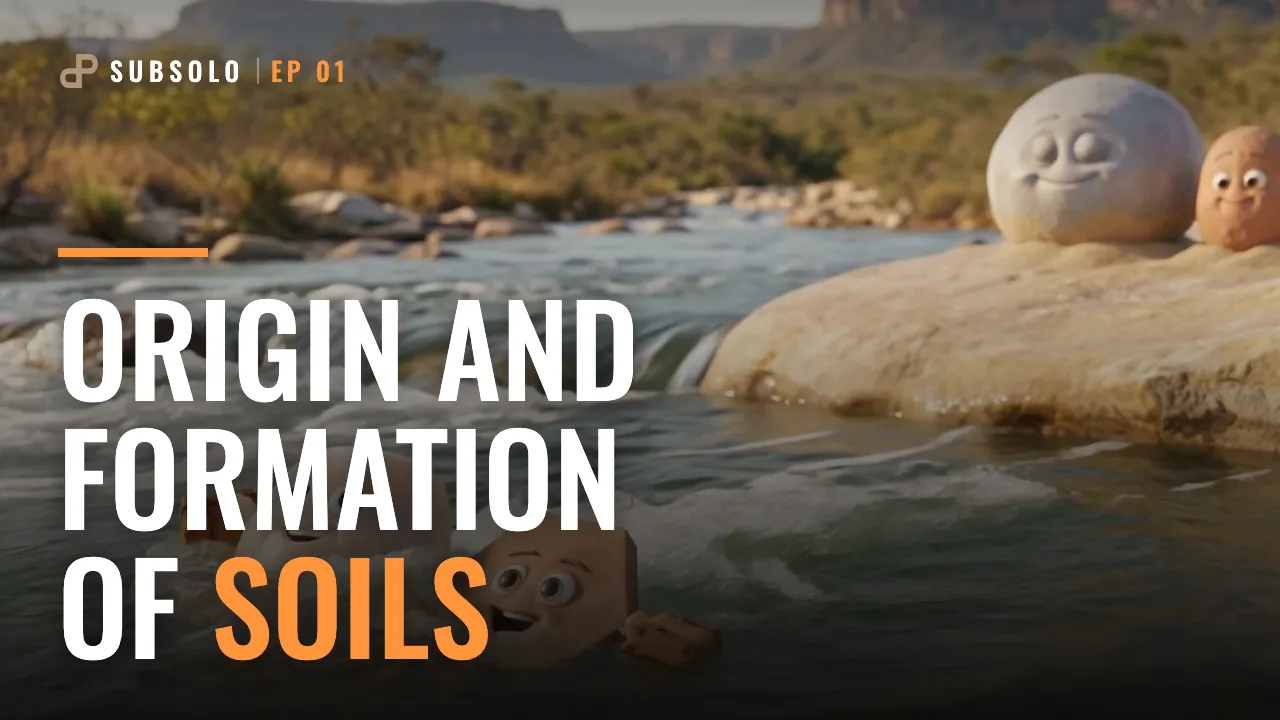
Every rock becomes soil. The episode shows the two tools of weathering, introduces the soil that stays and the soil that travels, and explains why two next door neighbours can build on completely different ground.
Prefer reading? The full transcript is right below. The timestamps jump to the exact moment in the video.
In three points
Almost all soil is decomposed rock. Sun, water and chemistry take the mountain apart, given enough time.
Residual soil stayed where it was born. Transported soil travelled and takes the name of its carrier: colluvium, aeolian, alluvium.
The river sorts grains by size. Alternating layers of sand and clay are chapters of the ground's story.
Narrated transcript
The episode in text
Full text of the episode narration. Click a timestamp to watch that part of the video.
A material that was once a mountain
Under every building, every road and every dam there is a material that was once a mountain. Almost all the soil on the planet was once rock. And nature uses two tools to turn one into the other.
The first tool: physical weathering
The first one is physical: sun by day, cold by night. The rock expands and contracts until it cracks. Water gets into the cracks and pushes. Pieces break loose.
The second tool: chemistry
The second one is chemical. Rain reacts with the minerals. In granite, feldspar gives in and becomes clay. Quartz resists. And quartz is what is left as sand. This work of sun, rain and chemistry has a name. Weathering. Slow for us. Unstoppable for nature. Give it enough time and the mountain falls apart into soil.
Every grain tells a story
That is why, in a handful of soil, every grain tells a story. Size and mineral tell you who resisted and who gave in.
Not all soil came from rock
But not all soil came from rock. In the sea, ground shells and corals turn into sand. And in the marshes, plant remains and living things give rise to peat.
Stay or travel? Residual soil
From rock or from life, soil has two fates. Does it stay or does it travel? The detective's question: were you born here, or where did you come from? The soil that stayed on top of its own rock is residual soil.
It is the classic Brazilian profile: mature soil on top, saprolite in the middle, weathered rock, sound rock. A block that resisted whole: the boulder, floating in a sea of clay.
The travellers: colluvium, dunes and alluvium
The soil that travels takes the name of whatever carried it. Gravity pulls the soil down the slope: colluvium. Wind carries the light grains and builds dunes. Aeolian soil. And the river, the most organised carrier of them all, carries, deposits alluvium and still sorts the grains by size.
Where it runs strong, only the coarse grains settle on the bed. Where it slows down, the fines finally settle. Thousands of years later: sand, clay, sand again. Each layer is a chapter of the river.
The detail that changes projects
A borehole crossing those layers is reading that story. And here is the detail that changes projects: each carrier picks what it is able to carry. The result is completely different ground, side by side, in the same city. Two next door neighbours can be founded on soils born kilometres apart.
Three things to take away
Three things to take from this episode. Almost all soil is decomposed rock. Residual soil stayed where it was born. Transported soil travelled. And the river also sorted the grains by size. And how big are those grains in the soil? Get ready. The answer does not fit in your eyes. That is the next episode.
Questions from the episode
What gets answered
What is weathering?
It is the combined work of sun, water and chemistry breaking rock down at the surface. Physical weathering expands and contracts the rock until it cracks, and water gets into the fissures and pushes. Chemical weathering makes rain react with the minerals and transforms them. Given enough time, the mountain falls apart into soil.
What is the difference between residual and transported soil?
Residual soil stayed on top of the rock that formed it and keeps the classic Brazilian profile: mature soil on top, saprolite in the middle, then weathered rock and sound rock. Transported soil travelled and takes the name of its carrier: colluvium (gravity), aeolian soil (wind) and alluvium (river).
Why does granite turn into clay and sand?
In chemical weathering, the feldspar in granite breaks down and becomes clay, while quartz resists and is left as sand. That is why the size and mineral of each grain tell who resisted and who gave in.
What is a boulder in a soil profile?
It is a block of rock that resisted weathering whole and ended up wrapped in residual soil, as if floating in a sea of clay. In site investigation it can be mistaken for the top of bedrock, and crossing it may require mixed drilling.
Why can neighbouring plots be so different?
Because each carrier picks what it can transport and deposits it in different places. Two next door neighbours can be founded on soils born kilometres apart. Drilling is what reveals which story is written under each plot.
From the episode to the field
Where this story becomes work
A borehole crossing those layers is reading the story this episode tells. These are the Damasco Penna services that do that reading.